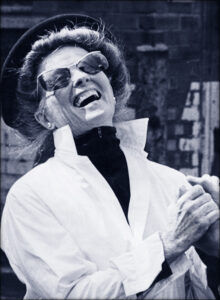
Norma appeared in my office doorway.
“Tom, Katharine Hepburn is on line one.”
It was nine o’clock on the morning of January 15, 1979. Three weeks earlier I had written to Miss Hepburn, as she liked to be called, enclosing a three-page scenario for a feature film that Bill Gibson (author of The Miracle Worker, Golda’s Balcony, and other plays) and I had written with her in mind. Neither of us knew her. It was a long shot. We really didn’t expect her to respond, but we hoped she might pass it on to her agent. However, we also knew she could ignore it completely or return it unopened—which is what most movie stars do when they receive something unsolicited in the mail.
Now she was calling me. I picked up the phone and said cheerfully, “Good morning, Miss Hepburn, this is Tom McCann.”
Ignoring my greeting, she said, “This is Katharine Hepburn and you, Mr. McCann, must be crazy. What made you and Mr. Gibson think that I’d be interested in playing this woman? She is everything I detest in a woman—or in a man for that matter. She’s a moaner. She’s a complainer. She is pathetic. She is a ‘why me’ kind of person. Why the hell not her! She is feeling sorry for herself, sorry because her husband died. She is feeling sorry for herself because she is lonesome. She wants people to feel sorry for her because she has an illness and because she’s in pain. Because her children do not visit her more often. Well, boo-hoo. Who the hell cares?”
I was stunned. Was I really talking to Katharine Hepburn? Though I wasn’t doing much talking. One of the most famous voices in the history of the movies was in my ear, delivering a blistering reaction to this scenario Bill and I had written and respectfully (I thought) sent to her. And she was only getting started. Becoming more and more upset, she let me have it. Her voice cracking, she said, “How dare you send me something like this! How dare you! What do you expect me to do with this thing?”
I started to say something. I don’t remember what. The words simply would not come out. My throat was dry. She repeated: “What do you want me to do with these pages?”
I said something to the effect that I was sorry I’d upset her—and then something stupid about it being a cold day in January and I was sure it was also cold where she was, so maybe she should just throw the scenario into the fireplace. It was a dumb thing for me to say, but it was all I could think of in the moment.
“As you wish,” she said and slammed down the phone.
That was it. My first conversation with Katharine Hepburn.
I would have many more conversations with this fascinating woman, but I didn’t know that at the time. My initial thought was to call Bill Gibson, but first I had to get myself under control. My face was flushed, and I was sure my blood pressure was over the red line. I felt stupid for not seeing the main character of our scenario the way she had, and I felt that Bill or I should have known. We were wrong, and she was right. I had upset an American icon! And, yes, I felt terrible for having upset a woman in her seventies—which to me, a man in his forties, seemed old at the time.
Norma came in and asked if I wanted a cup of coffee. I joked that I needed a double Scotch. Then the phone rang. This time I picked up. It was Katharine Hepburn—again!
She got right down to business. “Listen. I just want you to know that I have enormous respect for Mr. Gibson. I think I’ve seen every one of his plays on Broadway, and of course his Miracle Worker with Anne Bancroft was just wonderful. Very moving. Very memorable. I also saw his Golda here in New York. What you two fellows wrote was well written but simply not for me. And I have to tell you that I loved your letter to me. I liked the tone. It had the upbeat tone I like in a person. I was so looking forward to reading your scenario. My expectations were very high when I started to read it, and because my expectations were high, my reaction was so negative. So I’m calling you back to say that I hope someday you’ll both bring me something I can do, now that you know what kind of characters appeal to me. That is all I have to say. Think about it and talk to Mr. Gibson. Try again. Try again. Good day, Mr. McCann.”
She hung up.
Well, quite a morning. Quite a couple of phone calls. And I remember those calls so clearly not only because of the force of Katharine’s personality but also because that day marked the beginning of a relationship that would last for twenty years—from that initial low point to close to the end of her life. We became friends. Good friends. Less than a year after the first dreadful conversation, I was at her house in Fenwick, Connecticut, having lunch. A lunch she herself made—cheese and tomato on white toast. A first lunch that lasted until nine in the evening. And for another two decades we would share events and scenes from both our lives. We talked about everything, and I got to know the real Katharine Hepburn, who was nothing like the persona you saw when she was interviewed by a Dick Cavett or Barbara Walters. She was just the opposite. We never spoke about that first phone conversation.
A couple of weeks after those first calls, after several back-and-forth notes, she asked me if perhaps I’d been named after my father, who she thought may have been a well-known New York publisher. She was thinking of the firm Coward-McCann, which had been a very active book publisher in the thirties and forties. I should say that Katharine was a bit of a snob and very interested in names, family, and lineage. She could get on her high horse at times.
She was mistaken about my dad. He worked with books, all right, not the kind of books Coward-McCann published, but the kind that could—and often did—land him in jail. . . .