I’ve seen a black-and-white publicity photo, taken in the late 1930s, of the onetime “king” of Hollywood, Clark Gable, and the “love of his life,” his wife Carole Lombard. Gable is sitting behind the wheel of his custom-built Packard convertible dressed in a snap-brim fedora, an expensive Hollywood sport coat, a forward-point collar, and a silk tie, with a pipe between clenched teeth. He has one arm on the steering wheel and the other around Carole. She is stunningly dressed. Both are looking directly into the lens of the camera.
It is a perfect picture, and every time I see it, I am reminded of the first time I saw Uncle Freddie. I was on the stoop of the building where we lived in a third-floor walkup in Brownsville when he pulled up in exactly the same kind of a car, with the most beautiful woman I had ever seen beside him. He jumped out and opened the door for her, and she stepped out, wearing the highest heels I’d seen and a dress that gently moved with every step she took.
He took her arm, led her to the stoop where I was sitting with four or five other kids, and said, “Who wants to earn a dollar for watching my car?”
A dollar in 1940 was a Clark Gable–size tip. All five of us stood up. He picked one of us and said, “Kid, I want you to stand by the car. Don’t leave it, and don’t let anybody climb on it or sit inside.”
In those days a car like that was a target for kids to jump in, get behind the wheel, and pretend they were driving, making loud driving sounds and screeching-brake noises as they did.
That done, he said, “I’m looking for Mrs. Lynch. What floor is she on?”
“That’s my nanny,” I said. “Does she know you?”
“I’m your Uncle Freddie, Fred Unger, and this is my fiancée, Katherine Dowd. Your nanny was a good friend of my mother and father, and I’m sure she’ll be glad to see me.”
As we were going up the front steps, I got the first whiff of Katherine Dowd’s perfume. This was a day of firsts for me. I led them upstairs and into the cold-water flat Nanny and I lived in. Fred Unger was right: Nanny was very happy to see him. He said they were on their way to Aqueduct Racetrack, and they could stay only a few minutes. He promised he would come back again. He reached into his breast pocket and handed Nan an envelope. He told her he wanted her to buy something for herself and me, and for Uncle Arthur. He kissed her good-bye.
They walked off. I don’t think they were in the apartment more than ten minutes, and neither of them sat down. Nanny asked them to, but Aqueduct was calling, and as I learned later, Fred Unger loved the place. Before he left, Nanny asked him how the two hardware stores were doing, and he said there was only one hardware store now. He had sold the other one.
After they left, Nanny told me she had known his mother and father when she was married to Mr. Lynch, my grandfather, and living in another part of Brooklyn. Freddie’s father had owned two hardware stores long before chains like TrueValue and Ace came along. The Ungers always had cars and sent Fred to an upstate college. Nanny said the college “sent him back” after a year, saying that he was not a serious student and recommending that the Ungers try to do something about his drinking habit. A short time later, Freddie’s parents were killed in a car accident, and Freddie, who was then about twenty, inherited both hardware stores. He had no brothers or sisters. What Nanny didn’t know the day that Freddie Unger visited was that he had sold one of the stores to pay for the swell car and his substantial gambling habit.
Months went by, and we didn’t see Freddie again. One winter day when I was on my way to school, I opened the door to the vestibule leading to the outer door. Slumped over on the floor was a man, totally motionless. I first thought he was dead. But with the opening of the door, he stirred slightly. He lifted his head, and I could see that it was Fred Unger. He was in old, dirty, torn clothes. His face had dried blood on it, coming from his head and his nose. His hair was matted with blood and dirt. He had no overcoat. He smelled of urine and whiskey. I ran back upstairs to get Nanny, who came down. Together, she and I got him up three flights of stairs and into the apartment. She told me to continue on to school. She would take care of Freddie, and she would call Dr. Lauer if she felt he needed a doctor.
By the time I got home that afternoon, Nanny had moved Freddie into my room, and he was sleeping in my bed. She had cleaned Freddie up, and when his face and hair were washed and the dried blood was gone, he looked a lot better. He woke up later that night, and Nanny tried to feed him some soup and bread, but he had no interest in food. He never spoke a word, and he bore no resemblance to the energetic, smiling, handsome man that I had seen six or seven months earlier. He stayed that way for days, not eating, not talking, expressionless. He never left the apartment. He seemed to have no interest in himself or anyone else or what was going on in the world around him.
Gradually, after weeks of living like this, he began to talk to Nanny when the two of them were alone. He told her he sold the first hardware store to pay for the car, the clothes, living in the Hotel St. George in Brooklyn Heights, and the gambling—most of all, the gambling. He admitted to Nanny that he was caught in the grip of alcohol and gambling, mostly horses, but also cards, craps, anything where there was a chance of a jackpot. He told her he had lost the second store to gambling and owed money to bookies and loan sharks. It was they who had beaten him up. He said Nanny was the only one he knew who would take him in. He had no plans and no idea how he was going to pay off his debts or get out of the predicament he was in.
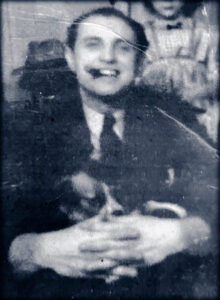
Now I recognize that he was very seriously depressed, but in those days, one just pulled out of one’s depression or didn’t. There were no drugs and certainly no talk therapy available. Nanny, with her quiet, nonjudgmental manner, was exactly what Fred Unger needed. He began to eat better, but he never left the apartment. Uncle Arthur used to come over every few days, and the two of them would talk. Uncle Arthur would always bring back issues of the New York Mirror, which Freddie said had the best racing pages. He studied them the way he had never studied anything at that upstate college. Uncle Arthur also kept Freddie in five-cent White Owl cigars. Freddie would slip off the paper cigar band, put it on my finger, and say, “Someday, kid, I am going to get you a real ring with a ruby the size of a dime.”
Everyone knows December 7, 1941, was the day the Japanese attacked Pearl Harbor, but there aren’t many people still around who remember where they were at the moment they got that news. I do. I was up in that apartment where Nanny and I, and now Uncle Freddie, lived. The three of us were gathered around our radio listening to that newscast. For the first time in months, Uncle Freddie showed some emotion. He was outraged at the news of the attack and kept assuring Nanny and me that it would be all right and that we would make “short work of those Japs.” He listened to the radio all that night and suddenly expressed interest in seeing newspapers. Pearl Harbor had a positive effect on his mental condition and a negative effect on mine. I was convinced that we were going to be overrun by hordes of Japanese soldiers invading our shores at Coney Island, Rockaway Beach, and maybe even Jones Beach on Long Island.
Soon afterward, a Western Union telegram came for Frederick Unger, informing him that he was being drafted into the United States Army and that he was to report to the Army Induction Center at Grand Central Station in Manhattan in fourteen days. A few days later, it was announced that we were also at war with Nazi Germany and Italy, but Uncle Freddie was convinced that he was “going to fight Japs in the Pacific.” The night before Freddie was to leave, we all went to bed early and agreed to get up early to say good-bye. Nanny wanted to make him a good breakfast. I was convinced he was going to die in the war. In those days, I thought everyone was going to die soon.
We got up early only to find out Freddie had already gone. Weeks went by, and we heard nothing. The weeks turned into months, and still nothing. About three months later, our bell rang and I ran down the three flights of stairs. Two men in suits were in the vestibule. Their shiny black sedan was parked in front of the house.
One of them said, “Is your mother home, sonny? We want to see her.” I explained that I didn’t have a mother, but I had Nanny, and one of them produced a badge and said they were from the FBI. I took them upstairs, and they got right to the point. They said they were looking for Frederick Unger, that he was a deserter and did not report for his army induction. Nanny told them he left the morning he was supposed to report, and we hadn’t heard from him since. They asked her if they could look around the apartment. They asked her if he left anything, any papers, or if she had any idea where he might be because he was not in the Army. They asked if he had a gun. They asked who his friends were. After they looked around, they left, but before they did, one of them read a paper to her that said that it was a serious crime to hide a deserter.
More than a year went by, and we heard nothing from Uncle Freddie or about him. For a while we thought he might have met up with those men he owed money to and might have been one of those unidentified bodies they used to find over the line in Queens, victims of gang violence. I was still sure that one way or another he was dead or going to die.
One day, more than two years after Uncle Freddie left, Mrs. King, the lady who lived on the first floor, came running up. “Mrs. Lynch,” she said, “the Journal American has an article about Fred. He’s a hero. You have to read it.”
Nanny took the paper, and we both began to read. The article was a full page devoted to the heroics of Lieutenant Fred Unger of Brooklyn. There were several pictures of him: posed on a tank with a machine gun, in various uniforms—fatigues and dress uniforms—with smiling partisans. My Uncle Freddie. The story accompanying the pictures told of Freddie’s infantry outfit capturing a German-occupied town in France and then losing it again to the Germans. Somehow, Freddie got trapped behind the enemy lines. He managed to break through those German lines and, in the process, did a lot of damage to a lot of German soldiers, captured one of their vehicles, threw a few hand grenades, and picked up two other American soldiers, who were also trapped.
He was wounded, and for that he got a Purple Heart, but he also got a few other medals. The biggest prize by far was the fact that he was awarded a “battlefield commission.” Overnight, SFC Fred Unger was First Lieutenant Fred Unger, even skipping over the Second Lieutenant rank. Two months later, around the time the article was written, he was promoted once again, to captain. My Uncle Freddie, a captain and a hero in France.
A few weeks later, a cardboard box came addressed to me, and in it was a collection of souvenirs, including a German helmet, a Luftwaffe pilot’s fur-lined hat with the ears cut out for a radio headset, a Nazi flag with blood on it (Uncle Freddie later confessed was port wine that he had intentionally spilled on the flag so he could tell me it was blood), a bayonet, a Nazi armband, some French and German money, and a wide, black leather belt that had an impressive silver buckle with a swastika on it. Thanks to Uncle Freddie, I was the most popular kid in our neighborhood.
The war ended, and Uncle Freddie came home soon after. He acted like he had a lot of money. We later found out he really didn’t, but people, particularly the saloonkeepers, wouldn’t let him pay for anything. They liked having him in their establishments because he told war stories, and he was an attraction.
He married a neighborhood girl, Rosalie, and opened a bar and grill called Heroes. But he started drinking and gambling once again and his bar closed after less than a year. From there, he got a job as a bus driver for the Green Bus Lines that went from City Line in the East New York section of Brooklyn to Jamaica, Queens. When I was a teenager, I would sometimes ride Uncle Freddie’s bus late at night and sit in the seat behind him just to be able to talk to him. I loved to talk to him.
On one such trip I asked him about the FBI and what that was all about. He made very light of it. He admitted he might have been a couple of days late reporting to the army at Grand Central, but it was no more than a few days and he got there eventually. He never said why he was late arriving; knowing him, I suspected it was more than just a few days.
He was drunk on the bus one night, and a passenger reported him. The following week, he was driving a garbage truck for the Department of Sanitation. He held that job for ten years. Between the drinking, the gambling, the depression, the career failures, and whatever else plagued Uncle Freddie, his marriage ended in a few years.
In 1971 Nanny died, and I met Rosalie at the wake. She told me Uncle Freddie was in an old-soldiers’ home in upstate New York. She visited him once a year, in the spring, and with each passing year his mind became more and more clouded. She suggested I write him a letter. When I got back to Boston, I bought the best box of cigars I could find and mailed them to him, along with a letter reminding him who I was.
Months went by, and I didn’t hear anything. I didn’t expect to. One day, an envelope came with an upstate New York postmark. Inside was a note, written on a small piece of paper, that said, “Mr. McCann: Captain Unger wanted you to have this.” It was signed, “Yours truly, his friend Sam Z.”
Taped to the note was the paper band from one of the cigars I had mailed to him. And I remembered that all those many years ago Uncle Freddie would slip the band off one of his White Owls and put it on my finger, saying, “Someday, kid, I’m going to get you a real ring with a ruby, a big ruby the size of a dime.”
I remembered, and Uncle Freddie did, too.