“Hey, Tomasso! I heard you was here. I heard you quit school. I heard you hit a priest. You know you go straight to hell for that,” she said.
“Can I help you with something, Santa?” I asked.
“Yeah. All’s I want is a box of Mickey Mouse mattresses.”
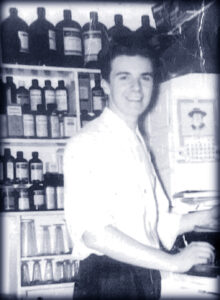
This was my first day behind the counter at the Lauer Pharmacy in East New York. Harold, the pharmacist in charge of the store, let me go behind the counter and wait on customers when he thought I was familiar enough with the stock so that I would look like I knew what I was doing. Santa Spinelli was my fifth or sixth customer that Saturday morning. I had no trouble with the others because they all wanted more or less the same thing: Bromo-Seltzer, Alka-Seltzer, Pepto-Bismol, or aspirin—the usual things sold on Saturday morning after a night of heavy drinking in a blue-collar neighborhood. I knew where all that stuff was, but not the “Mickey Mouse mattresses.” In fact, I had no idea what Santa was talking about.
Harold heard the exchange and came running out from the prescription area. “She wants a box of Kotex, Tom.” I went to get it and started wrapping it, feeling my face flush. In those days the subject of sanitary napkins and menstruation was an occasion for blushing for members of both sexes. While I was wrapping, Harold chatted up Santa Spinelli, the way he did with all the single women who came into the store. I finished wrapping the box of Kotex and tying it with red string and took thirty-three cents plus two cents sales tax out of the dollar she handed me.
As I gave her the change, Santa said, “Tell your friend Rocco to give me a call in exactly five days. That will be next Thursday. Don’t forget to tell him.”
“Suppose I give you a call next Thursday?” said Harold.
“You call my house, and my father will cut your liver out. He only wants me to date Italian guys and not all of them, either. Besides, you are too old . . . too funny-looking . . . and you’re Jewish.” She turned to me. “Don’t forget what I axed you to do. Tell Rocco . . . five days.”
Harold protested: “But I fought for your freedom overseas in World War II. I helped free Italy. We got rid of Mussolini. I could have gotten killed. Doesn’t that mean anything to you? Wouldn’t you like to go on a date with an ex-serviceman who is now a pharmacist and has a new Chevrolet?”
“How many times do I gotta tell you no? Even if I wanted to, what about my father? Get lost. Go find a nice Jewish girl, why don’t you?”
“I’m trying, I’m trying,” said Harold.
The next time Santa came in, she asked for a box of “manhole covers,” and I immediately knew what she meant. Every time she came in, she asked for Kotex by a different name, and some were quite creative and funny. One day she stopped coming in for them, and in a few months Harold and I could see why.
I didn’t know it then, but looking back, Harold Levine was precisely what I needed coming off the Prep and Father Hess experience. It was June 1948. I was fourteen and very much changed by the past six months. Before entering Prep, I had gotten a job at Roitman’s Drugstore, but Father Hess got in the way. Mr. Roitman had to replace me. Mr. Lauer, another druggist in the neighborhood, was willing to give me a job, and I started the day after I left Prep.
Mr. Lauer knew Nanny and liked her. He had a son, Arthur, who was a doctor about Nanny’s age, and in fact, he was Nanny’s doctor and delivered her last baby. Nanny named the baby Arthur, much to the displeasure of her husband, Mr. Lynch. But Nanny had enough of her own German mother in her to do what she wanted. Tragically, Dr. Arthur Lauer got pneumonia and died, at forty-four, six months after little Arthur (my uncle Arthur) was born. Years later, Nanny told me that she loved Dr. Arthur Lauer, and she felt that Mr. Lynch knew it.
I liked Harold Levine immediately, and I could tell he liked me. He was also a Brooklyn boy, born and raised in the very tough Williamsburg section. He was about twelve years older than I was, which made him about twenty-six. He’d been drafted into the Army when he was nineteen.
After the war, he enrolled in the Brooklyn College of Pharmacy. In those days it was a two-year course, and graduates were awarded a Ph.G., which stood for Graduate in Pharmacy. Back then, most people called the druggist “Doctor,” and druggists did do a lot of doctor things—things a druggist would get arrested for doing today.
After I’d been working at Lauer’s for a few weeks, Harold said, “I have two coupons to White Castle for a bag of burgers. How about we go there tonight?”
Everyone loved White Castle hamburgers; the bag of burgers was famous. There were twenty of them for a dollar. Of course, each burger was the size of a quarter on a roll that was the size of a half- dollar. Everything was steamed, including the rolls, so they were soggy. There was a sliver of dill pickle as thin as a dime, a few pieces of steamed onion, a dollop of ketchup, and a speck of yellow mustard. But they were delicious and filling. Large Cokes were a nickel.
We closed the store at ten o’clock, got into Harold’s new 1948 Chevrolet, and headed for the White Castle at Rockaway Boulevard and Liberty Avenue. Harold pulled into a space in the parking lot and went in and got our bags of burgers and Cokes. He insisted on paying for mine. I remember letting him because it would have taken me three hours to earn enough to pay for that meal. I was earning thirty-five cents an hour.
We had just opened our bags and were about to take the first bite when suddenly Harold started the car and raced into a space that had just opened up in front of the door of the White Castle. I asked him why he moved out of the space we were in. He explained that we’d have a better look at the girls going in the front door. He added that if he left the headlights on, we could get an x-ray effect from the girls who were not wearing slips under their cotton summer dresses. I don’t mean to imply that Harold was weird around girls, just that he was very eager.
After a few minutes we settled into eating our way through our bags of hamburgers, and Harold seemed to forget about the girl watching.
He told me about his Army experience. His basic training took place at Pine Camp in upstate New York in the dead of winter. He was always cold. He was placed in the infantry and was immediately sent over to Europe—to Italy, where it was still winter. He was still cold. When the Italian campaign was over, he was sent to England for some specialized glider training. He was still cold and now wet. He was in the D-Day invasion. He described those several days to me and was frank to say that he was terrified to see all the carnage around him and feared he would be next. Every dream was about death.
He requested that he be relieved and sent back behind the lines. That request went all the way up to the company commander, who berated him, refused his request, and in fact sent him out on patrols as the point man—usually the first to get hit. One day, in the height of a heavy skirmish, Harold simply couldn’t take it anymore. He cracked and decided that he was going to kill himself. Then he modified that plan. He took off his boot, put his foot up on a rock, held the muzzle of his M1 rifle to a point between his ankle and his toes, and pulled the trigger. That act, witnessed by others, not only got him sent behind the lines and, ultimately, home, but it also got him a dishonorable discharge.
At this point in the story, Harold took off his shoe and sock and put his foot on the dashboard. One would think that a bullet fired from right up against the skin would make a relatively small hole going in and exiting, but just the opposite was the case. His foot reminded me of one of those soft pretzels that they used to sell from pushcarts in Brooklyn. It was all gnarled and burned, apparently from the flash coming out of the muzzle of the gun, something Harold had not considered at the time. The sole of his foot—the entire length of it from his toes to his heel—was also badly damaged. Apparently, there was some serious nerve damage because he could no longer walk with his feet parallel to each other. The right foot, the one he shot, turned outward at a 90-degree angle, and when it got to about four inches off the ground, flopped down heavily as it hit the ground. The effect was most unusual.
Harold got very quiet after he told me his story. I told him my story about Prep and the sadistic priest. Once again, we went silent. After a few minutes, Harold said, “So we are really a couple of damaged people who need to get themselves healed.”
I think we both thought about those words for a few minutes. Neither one of us said anything. Harold was the first to speak. He said, “The thing that pisses me off is that as far as I can tell, I am the only GI who went all through Italy and France and came home still a virgin.”
We both laughed. Harold Levine and Tom McCann bonded that night, but in those days, men never used that word.
I have to admit that Harold was pretty homely. He was about five-six, very thin, with oily skin, a few facial moles, and thick, horn-rimmed glasses. He was also prematurely balding. But he was a great guy with a good job, a wonderful sense of humor, a nice car, and nice clothes. He loved music, liked nice places, and had a lot of other good qualities. For some reason he could just not connect with girls.
He blamed his lack of success with women on the fact that he could not dance because of his foot. He said that not only did he step on the foot of his dancing partner, but he also regularly tripped the couple dancing next to him. Harold tried everything. He spent weekend after weekend in the Catskills, where girls looked for guys and guys looked for girls. He drove 1,500 miles each way to Miami and back over a long weekend with the help of a pocketful of Dexedrine.
Apropos of drugs, Harold was quick to try anything new. I recall a tranquilizer called Miltown. Harold eagerly awaited the arrival of our first shipment, tried them, and pronounced that they didn’t work.
Harold used to regale me with stories about his days in pharmacy school, and one I particularly liked, though just the thought of it still sends chills through me, was the one involving mercury. We all know that mercury is a heavy, shiny, silvery liquid metal. Anyone who has ever broken a mercury thermometer knows it is very difficult to pick up. Another name for mercury is quicksilver. Harold told the story of one of his professors who conducted an experiment in class one day. He lined the floor with pages of the New York Times and then asked for a volunteer from the class. He poured some mercury into a one-ounce shot glass and told the student volunteer to drink it on command. He assured the student that no harm would come to him.
As soon as the student downed the shot of mercury, the professor, pointer in hand, started to describe where the mercury was in the student’s body moment by moment. He took his pointer and pointed to the student’s esophagus, then his stomach, then zigzagged the pointer across the abdomen as the mercury made its way through the intestines, and then across the ileum and into the descending colon. “Voila!” shouted the professor as the ball of mercury exited the volunteer’s pant leg and landed on the newspapers. Harold got very excited as he described how the mercury came out, about two minutes later—in one piece, exactly as it went in. Years later, of course, we found out that even small traces of mercury could be harmful to human beings.
The student volunteer for the experiment? Harold Levine.
Harold entertained me with other stories, such as the one involving Spanish fly. There’s a lot of folklore about Spanish fly and its use as an aphrodisiac. In fact, it is used in animal husbandry and has other medicinal uses. We had a dark-brown bottle of it in the drugstore. It was used primarily in hair preparations. In those days it was thought that very small amounts of Spanish fly could stimulate the growth of hair in people who were balding. Vitalis, once a very popular hair tonic for men, had an advertising campaign built around its sixty-second workout. You were supposed to apply it to your hair liberally and then massage it for sixty seconds, and you would get that “all-over tingling feeling.” That tingling feeling was supposedly from Spanish fly, or cantharides, stimulating the flow of blood to the scalp.
One day Harold took down the bottle of cantharides and took the stopper out and told me to put my index finger over the neck of the bottle and turn it upside down, just for five seconds. I did this, and, almost immediately, a large blister formed on my index finger. Spanish fly was a preparation made from powdered blister beetles, which apparently are found in abundance in Spain. It was this kind of fascinating knowledge and the way he told the stories that made Harold unforgettable.
Drugstores were very different in those days: The drugs were different, the stock was different, the prices were certainly different, and drugstore services were very much different. In those days the druggist, the “doctor,” would look at things such as a rash or a sore throat; take things out of eyes, from eyelashes to so-called cinders; remove warts with acid; change dressings; medicate an aching tooth with oil of cloves; weigh babies on the drugstore scale; and even splint broken fingers with adhesive tape and a tongue depressor.
Medicines, too, were a lot different in those days. For coughs, there were preparations called Brown’s Mixture, Stokes’ Expectorant, and a terpin hydrate elixir with codeine. There were nitroglycerine tablets for angina. There were very few things for pain. There were a lot of skin preparations: salves for rashes, cuts and bruises, creams for pimples, etc.
Most prescriptions were not simply taken from a big bottle and put into a small bottle, as they are today. A lot of prescriptions had to be compounded. It was not unusual for a doctor to write a prescription calling for perhaps four different powdered ingredients, an ounce or two of each. The pharmacist would have before him a pile of these ingredients that had to be mixed and then put into capsules. Frequently, the capsules would be filled too tightly, and we would be ten capsules short on a hundred-capsule order. My job was to open up the ninety capsules and take out a little bit from each so that we could fill the ten empty ones. It was an exacting and sometimes tedious business.
Every drugstore was individually owned in those days. There were no chains. The stock was far different from what it is now. Hairnets were a big item, as was foot soap. Most people took a bath only once a week, if then, but foot hygiene was very important, and people would wash their feet with a special foot soap every three or four days. There were basically only three brands of toothpaste, and there were three underarm deodorants, Stopette, Veto, and Arid.
Prices were very different, too. Five Gillette Blue Blades, which were the finest money could buy, were twenty-five cents; Gillette Thin Blades, in the red box, were three for ten cents; a large can of Johnson’s baby powder was forty-nine cents; condoms—Trojans or Sheiks—were three for fifty cents or a dozen for a dollar and a half. They were kept in a drawer in the back of the store, and in the four years that I worked at Lauer’s I never had a customer who was not embarrassed when he purchased them. If there were any women in the store, he would let them go ahead of him and wait until they cleared out of the store before asking for the condoms. Around the time that I got into the drugstore business, home permanents became the big thing. The two biggest were Toni and Lilt.
There was not much health insurance in those days, no such thing as copays, Medicaid, or anything of the sort. Film was taken to drugstores, and it took about ten days to get your pictures back, sometimes longer.
Because of the total failure of my first year at the Prep, it took me four and a half years to graduate from high school. I worked at the drugstore for a full four years and worked from four o’clock until nine, with a half hour (unpaid) off for supper. On Saturday I worked from nine to six with a half hour (unpaid) for lunch. I started off at thirty-five cents an hour, and four years later, I was earning fifty cents an hour. That meant I always had money in my pocket, but also that I was always working. As a result, I wasn’t able to participate in any high school activities or sports. But I was doing well in school, and I was getting another kind of education at the drugstore.
I learned a lot in that store from the people who were our customers. I learned a lot from Harold. Together, we did what he said we had to do that night in the car in front of the White Castle. We were both, as Harold said, “a couple of damaged people who needed to get themselves healed.” We both did a lot of healing in those four years.
When I graduated from John Adams High School, I left Lauer’s. Harold left around the same time. We drifted apart. I don’t know why. We should not have. Harold and I were close. We were friends. Friends should stay friends forever. I think of him often and wonder why I never kept in touch with him. A few years ago I tried to find him. There are a lot of Harold Levines in the New York metropolitan area and upstate New York, and even in Connecticut. I send out a batch of letters every so often, each with a return envelope, asking, “Are you my Harold Levine?” My letter describes a bit about Harold. One came back to me recently that read, “No. I am not your Harold. Wish I were. Keep looking until find him. Good luck. Harold Levine.”
“My” Harold is no doubt long gone by now. But I still I think of him fondly.