If you were born and raised in Brooklyn, you are going to have a Brooklyn accent. There is no escaping it. For eight years in elementary school, I was taught by the Sisters of Charity of Nova Scotia, who worked very hard to erase all traces of Brooklynese from our speech. There were no “dese, dems, and dose” among St. Sylvester’s graduates, though the pronunciation of certain words—like ball, floor, radiator, or car—marked us forever as being from that storied place. Even after ninety years, I still hear it in my own voice. Others hear it, too. I hear it on television shows and movies—particularly old movies. And today there are even coaches who teach Brooklyn accents to actors.
When I left Prep and decided to enroll in John Adams, one of the reasons I chose that school was because it had a teacher who, year after year, produced students who won the all-city public speaking contest. His name was Robert Sheppard. Right from the start, I plagued my Adams grade advisor, Dorothy Laws, to get me into Mr. Sheppard’s class. It took her two years, but she finally did it.
I was very excited my first day in his class. And impressed with Mr. Sheppard, starting with the look of him. He was tall and handsome and had a perpetual tan. Physically fit and impeccably dressed. I would have said Savile Row if I’d known what that was at the time. He always wore a starched white shirt with French cuffs. I had never seen French cuffs before. A different silk tie every day with a collar bar. He spoke in a soft voice that sounded a bit British—a cross between George Plimpton and Bill Buckley. It was impossible to tell where he came from but certainly not Brooklyn or Queens. Mr. Sheppard was fifties cool.
On that first day he asked every kid in class to stand up and state his name and read a short paragraph he put up on the blackboard. He called on every kid except me. At first, I thought he passed over me by mistake. But on the second day, he passed over me again. When he failed to call on me on the third day, I had no doubt for some reason he didn’t want me in his class. He was sending me a message, and I got it.
Because of my bad experience at Prep, and my failure at every subject there, it was going to take me four and a half years to graduate. I did not want to run the risk of making it five. I took myself and my Brooklyn accent to Miss Laws’s office and begged her to get me out of Mr. Sheppard’s class. She was not happy, but she suggested two other classes, one taught by Margaret Gannon and the other by Richard Hundt. In an instant, and really without thinking, I chose Miss Gannon. I think about that day a lot because had I chosen Mr. Hundt I never would have met Joan Frese. We fell in love, and I am happy to say we have been married for seventy years, but that’s another story. That decision, made in an instant, changed my life. Throughout this book, you will read about my obsession with chance, destiny, and the actions of others, and how these things have played a part in my life. I am obsessed with the what-ifs. There will be more.
Mr. Sheppard would go on to become the voice of the New York Yankees for over half a century. Reggie Jackson dubbed him the Voice of God. He became a celebrity, much sought after as a speaker, and appeared in several Hollywood films. But remembering those days in the classroom in the 1940s, I never felt kindly toward Mr. Sheppard and after fifty years I decided to write him the following letter:
Thomas P. McCann, President
Commonwealth Films, Inc
223 Commonwealth Avenue
Boston, Massachusetts 02116
August 20, 1999
Mr. Robert Sheppard
c/o The New York Yankees
Yankee Stadium
E 161st St. & River Ave.
Bronx NY 10451
Dear Mr. Sheppard:
It’s taken me 50 years to write this letter. I don’t know why it’s taken that long except that I’ve been busy.
Fifty years ago, I walked into your public speaking class at John Adams High School, spent two days there, and decided I had better get out. I came to the conclusion that I would never learn to speak like you or even like Ronald Hengen, your protege that year. Rather than be miserable for the rest of the term, or perhaps even flunk the course, I went to see my grade adviser—Miss D.B. Laws—and asked her what else she had to offer me. She suggested a dramatics class with Miss Margaret L. Gannon, so I said good-bye to Mr. Sheppard and hello to Miss Gannon.
That first day in the class I met a young blonde girl named Joan Frese, I didn’t know it then, but a few years later we would get married. There have been many turning points in my life, as there are in everyone’s, but by far the most significant one was my decision to leave your class. As a result of that decision. I had four fantastic children with Joan, and in 1960 she caused me to move to Boston which gave me a wonderful career. Lots of other good things have happened to me along the way.
I think of you often for really starting it all, even though you didn’t know it then. I was reminded of you again just the other night when I saw a program on PBS about the Yankees and heard your voice introducing Phil Rizzuto—it took me back to those days at John Adams, and I promised myself that I would write to you before the week was out and before our time runs out. I just turned 65; you must be at least 100!
Thanks, and with all good wishes.
Cordially,
Thomas P. McCann
PS: In Act I, I had a fascinating career with the infamous United Fruit Company. I wrote a book about that experience published by Crown 25 years ago. It did very well both with reviewers and in terms of sales and was ultimately printed in about eight languages including Russian and Japanese. Here’s a copy. I hope you enjoy this collection of banana war stories.
I hoped he would pick up the note of sarcasm in my letter. I never expected to get a reply, and I was very surprised when I did. His letter was very gracious, and I loved his line about how things started happening for me after I left his class!
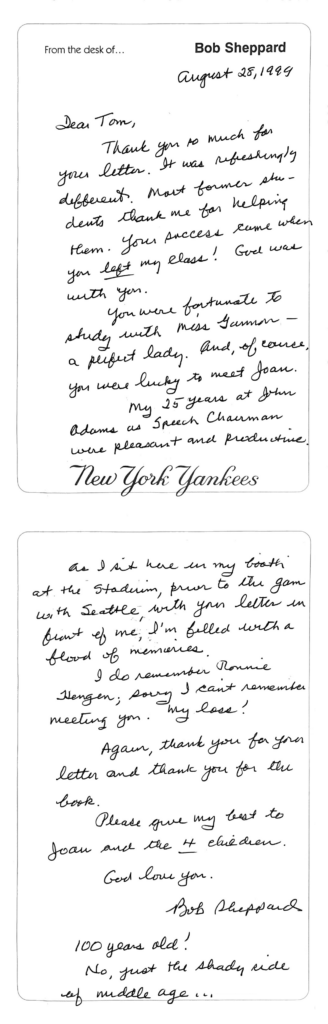
However, I was still left to wonder why Mr. Sheppard didn’t like me or why he didn’t want me in his class. When he died at the age of ninety-nine, I read all the obituaries. Most noted that all his life he was a very strong Catholic. He was a daily communicant, which meant he attended mass and received communion every day of the year. He had a daughter who was a nun. Here, I believed, was the answer to my question.
When I applied for admission to John Adams, I was interviewed by Dean Marie Keller. I had to tell her of my problems at the Prep, including that I had hit a priest after he hit me and put a big gash in my head. She called Prep while I waited outside her office. She called me back into her office and, after giving me a long hard look, put me on probation. I’m sure that my history was made a matter of record. Mr. Sheppard, I’m also sure, either read my record or heard about it and that was why he didn’t want me in his class. It would not have mattered to him that the priest hit me first and I hit him back. Not to a daily communicant.
PS: I also learned from reading his obituaries that he was born in Richmond Hill, Queens, generally accepted to be the home of Archie Bunker of All in the Family. Bob Sheppard also came a long way.
Requiescat in pace, Mr. Sheppard.