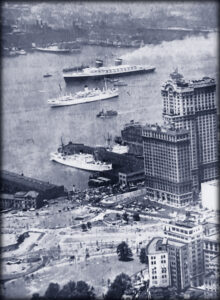
The day after my chat with Joe Brennan, I started my job in the passenger department of United Fruit. I hated it. I ran all over New York City, picking up airline and rail tickets, getting tourist cards from the various consulates, filing, getting coffee and lunches, running errands, delivering interoffice mail to a dozen different departments, going to the post office, and even taking the boss’s dirty shirts to the laundry.
The one good day in the week was Friday. The company had a fleet of a hundred and fifty ships. Most of them were freighters carrying twelve passengers, but six of them carried ninety-five passengers each. They sailed from a wide range of US ports, including one every Friday from New York. So that was an especially busy day for us in the passenger department. It was also exciting. Successful people from all walks of life took the cruises: movie stars, politicians, people whose faces I knew from their photographs in newspapers, magazines, and the infant industry of television. The cruises from New York lasted seventeen days and included exotic and interesting stops in places like Havana, Jamaica, and the Canal Zone, with a further stop in a colorful banana port in Central America before heading back to New York.
One of my interoffice mail deliveries was to the office of the port purser, a man named John Caldwell. One day, when I’d been working in the passenger department for three months or so, I delivered a piece of mail to his office. I got an idea. A chance perhaps to escape the tedium of my current post. He was alone at his desk, and I knocked and asked if I could see him for a minute. A big Irishman with a slight brogue, he was very welcoming and invited me in. I told him I was an aspiring writer and wanted to see the world—isn’t that how writers got their start? Could I get a job aboard ship? (Of course, I knew that the Irish love writers.) He listened but explained that union rules did not permit nonunion employees to work on the ships, but he added that if a position opened in his office, he would let me know.
Two months later Mr. Caldwell called me and said, “Tom, this morning we took one of our chief pursers to the hospital with a burst appendix. He’ll be out for at least a month. We’re moving our second and third pursers up and there’s a slot for a third purser in training. I can sign you on as a cadet to get around the union. Are you interested?”
Was I interested? Of course. He told me that I needed to be there by three o’clock that afternoon to get suited up in uniform and be ready to sail at four. The other pursers would explain my duties. It was already one o’clock, so I ran home, borrowed a suitcase from the man next door, threw some socks and underwear into it, and made it to Pier 3 with time to spare.
I was still only eighteen years old. I had never been south of Coney Island. That sailing, my first, was on the first Friday in December 1952, a miserable day: cold, rain, fog, and sleet, with a biting wind off the river. Our ship, the Veragua, backed out of her slip at Pier 3 and into the mainstream. We had just passed the Statue of Liberty, and I was on my way to the ship’s lounge to take drink orders when I noticed a woman who looked like the actress Joan Crawford standing at the rail, smoking a cigarette. She wore a tightly belted tweed coat and seemed completely unaffected by the nasty weather. I stopped and politely asked if there was anything I could do for her. Looking at me coldly, she said, “Yes. You can get lost.” Shocked, I backed away.
A day and a half later we were off the coast of Cape Hatteras, a spot I’d been told was always rough sailing. Half the passengers on board were on deck getting tossed around and trying hard to minimize the effects of seasickness. I saw the woman in the cloth coat at the rail, keeping her distance from the other passengers. I tried to sneak past her, but she saw me and with her index finger motioned me over. “If you still want to do something for me,” she said, “you can get me a cup of coffee and a deck chair.”
“Yes, ma’am,” I replied.
“And get one for yourself,” she added.
I explained that I was just a server, and that the crew were not permitted to fraternize with passengers. She looked at me the way Mrs. Robinson looked at Benjamin Braddock in The Graduate. “We are not fraternizing,” she said. “Just do as I told you.”
So I did. I returned with the coffee and deck chairs. She sat on one, and I sat on the other. The ship careened on the rough sea, the coffee spilled, and our chairs slid across the deck. After a while the woman said, “Do you know who I am?”
“I’m sorry. I don’t.”
“I’m Ann Whitman. I’m the personal secretary to Dwight Eisenhower, the man who was elected president of the United States five weeks ago. I’m sure you’ve heard of him.”
I said I had.
“Oh. Are you even old enough to vote?”
Without waiting for an answer, she explained that President-elect Eisenhower had given her an order to take a two-week vacation. He thought she needed a rest. She wasn’t happy about it. And she added that she didn’t think she could last seventeen days on the ship. We chatted. Or she chatted and I listened. For whatever reason, this high-powered, highly stressed woman felt comfortable talking to this eighteen-year-old boy. And we would keep talking. For the next fifty years.
Our first stop was Havana. This was quite an eye-opener for an eighteen-year-old Brooklyn boy. All the passengers disembarked and stayed two nights at the Hotel Nacional, except for Ann Whitman, who remained on the ship and stayed for the most part in her stateroom. During the day, I did a lot of running around with import manifests and other business, but I was free to see the sights of the city at night.
On that first night the radio operator and the chief steward took me under their wing, and we had dinner at the hotel. The food was good and the entertainment, mostly dance music, was first rate. And there were a few comedians who as I recall were somewhat risqué. Again, that kind of entertainment was something I wasn’t used to. Between acts, “Superman of Havana” came out. His only job was to stand in front of the audience in his Superman costume and open and close his cape. He wore the Superman shirt with the big “S” and blue leggings up to his knees, but he had no underwear on. The audience was astonished.
Years later, I saw this character used in The Godfather Part II, when Michael Corleone realizes he has been betrayed by his brother Fredo. At that moment, the camera cuts to a brief shot of Superman opening his cape to another brief shot of the audience reacting and then back to Fredo and Michael. The scene goes by so quickly you have to watch carefully. And you still might miss it.
That was the first night in Havana. The second night was even more memorable—in fact, unforgettable. The radio operator took me to another place to eat, a waterfront dive. After our meal he led me through the kitchen and down a narrow hallway into a small “theater” that was barely larger than its single piece of scenery—a large bed with no sheets on it. There were small chairs all around the bed, all of which were occupied. The “players” arrived about five minutes after we did. By that time, we had been served rum drinks in coke bottles.
I began to get an idea of what was in store. A young man wearing candy-striped Bermuda shorts and with an ugly knife scar on his forearm, from elbow to wrist, entered, along with a woman who was older, about thirty. Both seemed bored or perhaps angry. They wasted no time in preliminaries. The stench of perspiration and smoke in that small, closed room made me feel like I was going to throw up, and I took a quick gulp from the coke bottle, gagged, stood up, and pushed my way to the door. I went outside and vomited in the gutter. A while later the radio operator came out, and we walked back to the ship. I had to carry him up the gangway.
The next morning, I met Ann Whitman on the deck. She said, “I saw you carrying your friend on board last night—or rather this morning. If you continue with this life, that will be you in ten or fifteen years.” She went on to describe the radio operator’s life perfectly—twice married and twice divorced, with children with both women, and a hopeless alcoholic likely to have an early death. “If that’s the kind of a life you want,” she said, “you’re on your way. But if you want to explore an alternative, I could introduce you to my husband, who is director of publicity and advertising for this rotten company. Let me know if you want me to do that.”
I thought about what she said, and before she got off in Kingston to fly back to New York (she had no intention of staying for the full seventeen days of the cruise), I told her I was interested in talking to her husband. Two weeks later, when I was back at work in New York, there was a message for me to call Mr. Whitman. I did; we met. He offered me a job as a clerk typist in his department. Another fateful moment. Another turning point.