The United Fruit Company was a very complex operation. It sourced its product in a so-called banana republic, with all of its political problems, and shipped a highly perishable product over a long distance, doing its best throughout to stay within the boundaries of the law and dealing with various public relations problems, not the least of which was labor unions. Over the decades, hundreds of consultants, lobbyists, and fixers were on the payroll to address the challenges of this complexity, including congressmen, senators, and even White House advisers like FDR’s famous adviser “Tommy the Cork” Corcoran.
Naturally, most of these connections were kept very quiet, even secret, and payments to them were often obscured. Edward Bernays was paid as much as $100,000 a year going back to the 1930s. Often such payments were disguised as subscriptions to publications, such as CIA operative William Gaudet’s Latin American Report, or as public service ads that the company ran in publications it hoped would portray United Fruit in a positive light.
Politics was an important reason for this secrecy. Founded in 1948, the United Nations had many left-leaning employees in the 1950s who were coming up with one scheme after another to restrict businesses like United Fruit, including the Special United Nations Fund for Economic Development (SUNFED), which had been established to support the expropriation of millions of acres of undeveloped land United Fruit had purchased in Guatemala. As I mentioned in the last chapter, I believed at the time that such expropriation posed a real political threat to the United States.
Alice Widener was a militant anti-communist who owned and wrote for U.S.A. magazine. She was also an expert on the United Nations. The company put her on the payroll to the tune of two thousand dollars a month. One of my jobs in the public relations department was to process bills, including two thousand dollars in subscriptions to her magazine. Mrs. Widener called me almost every month, asking me to expedite that monthly payment.
One month in the spring of 1953, she called and asked for payment that same day. I brought the payment to her house on Park Avenue. I was astonished when I arrived. I had never seen an apartment like it, a corner duplex with lots of windows. It was loaded with antiques, French Provincial furniture, and a grand piano, all tended by an attractive French maid named Henriette, who didn’t speak a word of English. There were bells all over the apartment to call the maid, and she was called a lot.
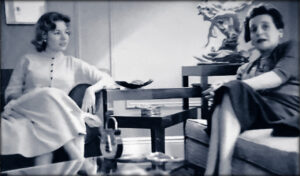
Alice Widener was about fifty at the time, brilliant, articulate, attractive, and, as the saying goes, to the manor born. She invited me to sit down in her white and gold living room and offered me a glass of sherry and some exotic hors d’oeuvres. She told me a little bit about herself (very little as I later found out). The daughter of a wealthy Jewish merchant in New Orleans, she had tutors as a child, went to school in France, and had to flee when Germany invaded France during the war. She married the Russian composer Nicolai Berezowsky and had two children. She had friends in high places, many of whom I would meet in time.
After sherry, Alice invited me to stay for dinner, served on fine porcelain trimmed with gold. Even the silverware was gold-plated. The food was nothing like I’d ever had before. We started with escargots and moved on to cold fruit soup, roast duck, and a compote of vegetables, not one of which I could identify. After dinner, we returned to the living room, and she asked me to tell her everything about myself. As I told her about my early life, she closed her eyes. There were times when I thought she was asleep, but if I stopped, her eyes immediately opened and she told me to continue.
When I finished, she said, “I think you have the makings of a writer. Did anyone ever tell you that? You tell stories with an economy of language, which is something I like and demand of my writers.”
Then she asked me to write something for U.S.A. magazine. I asked her what she had in mind, and she said, “I’d like you to review a book, The Untold Story of Panama, by Earl Harding. It’s a good book and I would like to see what you could do with it. I’ll pay you twenty-five dollars, and you have two weeks to write it. No guarantee I will publish it. Deal?”
A week later, I brought her my draft of the review. She read it immediately and made very few suggestions. And so began my long and rewarding relationship with Alice Widener.
She gave me a few other assignments and spent more time editing than she did with the first piece. The only reference book on her desk was Fowler’s Modern English Usage. She spoke at some length about what a great literary work it was and gave me a copy with entries in the index marked in red pencil—the parts she said I must read. The only two reference books on my desk today are that copy of Fowler’s and a 1945 edition of Webster’s Collegiate Dictionary. They are cherished possessions to this day.
Every Friday evening, Alice had a dinner for six or eight people, including a guest of honor. After a few months, she invited me to attend. She thought it would be interesting and would add to my social ease, as she called it. The guest of honor at the first dinner I attended was the actor Adolphe Menjou, who was very famous in the fifties. He was an ardent anti-communist and one of the great supporters of Senator Joe McCarthy and the House Unamerican Activities Committee (HUAC). The day before the dinner, Mrs. Widener told me, “Of course, you’ve seen Dolph’s work. But I know you’re going to be nervous meeting him. If you start to feel nervous around him, just remember that he puts his pants on one leg at a time.” She hesitated, then added, “No, with somebody like him, you have to remember that he sits on the toilet just like everyone else.”
The next night, I was sitting at table with Mr. Menjou. At one point I asked him a question, and he turned to me and said, “Young man, you have been mispronouncing my name all evening. Our hostess will tell you after I leave how to pronounce it. So, to help you this evening, you may call me Dolph, and I will call you Tom.”
I was so embarrassed, I wanted to leave the table. I looked over at Alice, and she winked at me. Remembering her advice, I pictured the great Adolphe Menjou on the toilet. And I did that a couple of other times at other dinners, so that over the years, things got a lot easier for me, whether the guest of honor was General Leslie Groves, father of the atomic bomb, or the Danish UN diplomat Paul Bang Jensen, who kept a list of Hungarians who had testified about Russian brutality during the invasion of Hungary and was under enormous pressure to make that list available. He resisted, the pressure continued, and one day he went to the roof of the UN building and burned the list. A short time later he died by suicide. A few months later, his widow was Alice’s guest of honor.
At these dinners I was able to observe the effect Alice had on the famous men she invited. She was attractive but also brilliant, and I learned that an intelligent, articulate, charismatic woman is a powerful aphrodisiac to many men. She did not want for male companionship. I was not married at the time, but Joan and I were planning to marry in a year or two and she had been part of my story when I first met Alice, who later asked me to bring Joan to dinner. Alice believed the most important decision of a man’s or woman’s life was who they married. I agree.
Alice could be eccentric. My job at United Fruit occasionally took me to the Pan American Union in Washington, and one time Alice suggested that we go down there together because she had some business there. She was a very nervous flyer, and I thought then, and still do, that she wanted me along to keep her company. We boarded a Lockheed Electra at LaGuardia Airport. To keep herself distracted, she brought her knitting. All of a sudden she jumped up, screamed, and announced that one of the knitting needles had slipped through a crack in the seat and she was afraid that it would interfere with the landing gear in the tail of the plane (we were sitting in the tail because she knew that, in the event of an accident, the tail was the safest place to be). She called for the stewardess, who tried to calm her. She demanded to see the captain. The copilot came back and explained that there was no tail gear on the Electra. She remained unconvinced.
As Alice helped me grow as a writer, I did my best to help her. She wrote articles on business and finance that I believed could have a much wider audience beyond U.S.A. I suggested she should try to syndicate her columns. She agreed it was a good idea and gave me the assignment. In those days, there were 1800 newspapers in the US. I picked the top two hundred and offered both of those columns to them at no charge. A dozen or so, mostly small newspapers, took me up on it. We were encouraged and moved to a second offering, suggesting that the papers, if they used the columns, send us a check at their “usual rates.” (We had absolutely no idea how to charge for the columns.) We started getting checks ranging from five to twenty-five dollars per column. In about a year, Alice’s columns were syndicated weekly in over a hundred papers. I was happy to do this and repay her for the help she had given me.
I wasn’t the only young man she helped. Alice mentored others, including Richard Whelan, who went on to work for the Richmond News Leader, the Wall Street Journal, and Time/Life. Eventually, Dick, with whom I stayed friendly, became a speechwriter for Richard Nixon. He quit when Nixon announced Spiro Agnew as his running mate. Dick told me his quitting had nothing to do with Agnew, but with the men he called “the Hessians” around Nixon—Kissinger, Ehrlichman, and Haldeman. Later, he wrote speeches for Ronald Reagan, and his papers are in the Reagan Library.
Another of Alice’s protégés was Douglas Caddy, a student at NYU, who lived at Alice’s apartment on East 73rd Street, in a building that also housed Frank Sinatra and the Gabor sisters. Caddy would go on to become an attorney for the Watergate burglars. In his book Being There, he wrote of his days of living with Alice, including those weekly dinners. He also claimed that she worked for the FBI, reporting on Communist cell activities in the New York area. And, in fact, she was very close to J. Edgar Hoover and key FBI officials in their New York office.
By this time, I had moved to Boston. I saw Alice on my visits to New York and occasionally she would come to Boston to visit one of her clients. We stayed in touch until her death in 1985. TheNew York Times carried her obituary. Her tombstone bears her name, the dates of her birth and death, and in large letters the word “PATRIOT.”
She was that. And more.