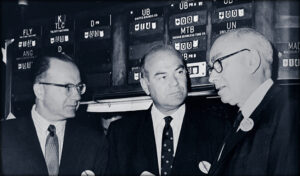
The arrival of Tom Sunderland at United Fruit moved the company into a new era. He upgraded management, had new equipment and technologies installed, put a welcome and important emphasis on marketing, and instituted new standards for quality control. We thrived. Production and profits increased, and the share price rose. And when I finally got out from under Mr. Big’s control and reported to Jack Fox—one of Sunderland’s excellent hires—my own situation also improved.
Yet working for Sunderland was a challenge. He had an insatiable thirst for personal publicity, and no matter how successful I was in getting United Fruit stories into the media—including a very favorable piece in Time magazine—he wasn’t satisfied. His photo in Time wasn’t enough: He wanted to be on the cover. I always felt that what I was doing was not quite good enough. But he was good, and by the mid-sixties the company was back earning reasonable returns. The stock was recovering, and key employees were rewarded with salary increases and stock options. The company began to make some acquisitions, including Baskin-Robbins, Foster Grant, and A&W Drive-ins.
On a personal level, I also continued to do well and was rewarded with salary increases, bonuses, and stock options. In 1969, I became the youngest vice president in the history of the company. I worked hard. Long hours. A lot of travel. A lot of stress. But I loved it and thought it would last forever. I was wrong.
It took place over half a century ago, but I remember it as if it were yesterday. September 24,1968. Jack Fox called a meeting of the company’s management committee for two o’clock. It was a routine weekly meeting, which always began with a report by the finance department of some key indicators of the business, followed by reports from production, sales, and shipping. At about three, Jack’s secretary tiptoed into the boardroom and handed Jack a note. He read the note and put it down in front of him. A few seconds later he picked it up and read it again. He passed it to Herb Cornell, the company president (by this time, Sunderland had been “kicked upstairs”). Herb read it and passed it back to Jack, who slid it over to me. The note read:
Specialist office at NYSE advises that 733,000 shares of United Fruit stock sold this afternoon. Third largest transaction in NYSE history. Buyer not known. Will advise soonest.
As the saying goes, my blood ran cold. Jack adjourned the meeting, and he, Herb, and I went into his office, along with general counsel, Victor Folsom. Everyone knew something big had happened, but none of us knew exactly what and what it meant for the future. Jack said, “l have no idea what this is all about or who bought the stock, but one thing is for sure: We have a new shareholder and he is our largest.” As he spoke, Jack’s private line rang. It was Bob Raymond, the NYSE specialist in United Fruit stock. Jack put him on speaker, and he told us that the buyer was AMK Corporation. The principal was Eli M. Black. Raymond said it was a block of shares put together very quietly over three or four months by Donaldson, Lufkin & Jenerette, a relatively young but very aggressive brokerage firm. I knew of them because my longtime secretary got a job there after she retired from United Fruit.
The others had never heard of Black or his AMK. But I had. Eight months earlier, I had been traveling from JFK to London on PanAm . It was a beautiful Boeing 707. It was a crystal-clear day and we were wheels up at precisely nine a.m. In those days, if you were in first class, you could get a drink before the plane reached its cruising altitude. I had a fresh Bloody Mary in my hand as we ascended. I was feeling good. I was also aware that I was sitting next to Benjamin Sonnenberg, a well-known public relations consultant who represented celebrities and major corporations.
I knew that Sonnenberg was involved in major acquisitions, mergers, and hostile takeovers. His fees were enormous. He was known for lavish parties at his house on Gramercy Park South, and he was an avid collector of art and antiques. He was flamboyant in his dress and mannerisms. He wanted to be noticed, and he was.
He held out his hand and said, “Ben Sonnenberg. My spies tell me you are Tom McCann. Now you tell me who you are and what you do for a living and why you’re flying to London.”
Very New York. I liked him immediately and by the end of the trip he said he liked me and offered me a job. He said I should be looking for a job because my company, United Fruit, was “in play.” I asked him what he meant. He said the company would soon be raided by “takeover artists.” I told him , in my opinion, that was impossible. I told him that our board included principals from Paine Weber, Lazard Freres, and Lehman Brothers. He scoffed at that and said some very disparaging things about all three firms. They were “out of it,” he said, and not in tune with the new corporate raiders.
“I know what I’m talking about regarding United Fruit,” he said, “You’ll see. Think about what I said. Think about my offer. Call me.”
A few months later he called me and gave me the name of Eli Black and AMK. He said a relative of Black’s had let it slip that he was lining up blocks of stock. I called Doremus, our financial PR firm in New York, and asked them to send me whatever they had on Black and AMK. They did. I read it and passed it to Jack. Nothing happened.
Just after we got the news from Bob Raymond, Jack’s secretary told us that Eli Black was on the phone. We listened on speaker. Black said he was at LaGuardia on his way to Boston. He suggested that he and Jack have dinner at eight o’clock at the Ritz Carlton. Ever cool, Jack firmly said no to dinner but agreed to meet Black at the Algonquin Club at seven. He said he’d be bringing a few of the company’s executives with him.
The events of that afternoon shocked us, but something like it was not entirely unexpected. We knew the possibility existed. But we were interested only in going our own way. After ten years of decline, the company had turned around. If there were any acquisitions, we would be the ones doing the acquiring. But you would have to be asleep, naïve, or incompetent not to know that a hostile takeover attempt was a possibility. At Jack’s direction, I had even put together a plan detailing how we would respond to an attack. I entitled it “Operation Pearl Harbor.” It called for us to issue an immediate press release saying that United Fruit Company was not interested in a merger. We would discourage any move in that direction by any company or individual, and the company would vigorously fend off any such a move. A draft press release was included in the plan. There was also a draft of a letter to shareholders telling them to stick with us and not to be fooled by any offers.
At our September meeting, I wanted to move forward with the plan. Herb disagreed and said we had to meet and hear Black out and then decide what we would do. He said that my suggestion would be viewed by Black as a hostile act and by Wall Street as an indication that the company’s management was more interested in preserving its own position than advancing the interests of the stockholders.
What we didn’t know then was that Black had to borrow all the money to buy 733,000 shares to acquire 9 percent of the stock. Nor did we know that he had to disclose to his lending bank what he planned to use the money for, or that his loan agreement stipulated that the loan would need to be repaid immediately if there was any indication that the company was opposed to a merger or takeover. If we had immediately expressed our intention to fight, the loan would have fallen due—and Black did not have the money to repay it. Chances are the stock would have taken an immediate big hit, resulting in those 733,000 shares being worth less. How much less no one knows. Just less.
The Algonquin Club meeting was tense. It was also brief—under an hour. Black tried to be cool but was nervous. He said he bought the stock because he felt it was a good investment. He said he felt the stock was undervalued, and he expected it to climb. He thought it might even increase on the news that he’d bought a big block. He said he had no intention of a takeover of the company: He was simply now the company’s largest shareholder, and he hoped the board would welcome him as a new member. His parting comment had to do with his honesty, integrity, and business acumen. He hoped that when the management group got to know him, they would find he had considerable business skills, was a creative thinker, and was someone who had valuable connections in industry and government.
None of what he said proved to be true. In the space of just a few hours, all our lives changed. It was the beginning of the end of United Fruit. The end of all our careers and the death of the company as we knew it. It was also, I believe, the beginning of the tragic end of Eli Black.
Within a year of the raid and eventual takeover of the company, most of the officers were gone, including Jack and Herb. There were major changes on the board and a lot of new faces. Eli’s group tried to run the company. They failed. They took it all apart, and they could not put it back together again. And me? My days were numbered. It was only three years since I’d been made vice president. I was not yet forty. I decided to hang in and give Black and his team a chance. Was that a mistake? Maybe. But I was still young, with many more turning points ahead of me.