Not all the men I looked up to were necessarily solid, law-abiding citizens. In fact, one of them was a serial bank robber born not far from where I was born in Brooklyn. Willie Sutton robbed banks for forty years, earning the nickname “the actor” because of his mastery of disguise. With each robbery he assumed a different look. Despite this skill, he was frequently caught. I liked everything about him, including the fact that the guns he carried, sometimes even a machine gun, were never loaded. “Loaded guns are dangerous,” he said. “Someone could get hurt.” He was a benign character who loved people and was generous to people in need.
Willie was a mythic figure in my neighborhood and around the country. He was sighted regularly, and people would swear they saw him in one of his disguises on a bus or in a grocery store. To me, Willie was cool. He was nonchalant about everything. It takes a special kind of person to walk into a bank, intending to rob it, knowing that there are silent alarms, bulletproof glass, steel vaults, hidden cameras . . . and armed guards ready to shoot to kill. Willie was also a great storyteller who had a way with people. He charmed everyone, even the police and his jailers. He could have been a lot of things, but robbing banks was what he chose to do in life. And he loved his profession. When he was asked why he robbed banks, he replied, “That’s where the money is.”
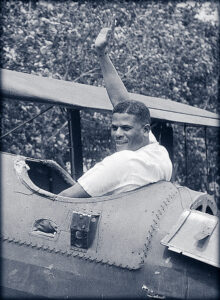
Another complicated character I admired was Colonel Hubert Fauntleroy Julian, who I read about in the tabloids. Julian was an internationally renowned fighter pilot and adventurer who was a native of Trinidad and had moved to Harlem in the 1920s. I was interested in flying (as I still am), and Julian appealed to me a consummate adventurer. Growing up in Brooklyn, I craved adventure and thought that flying would get me away from those streets—and who doesn’t want adventure in their life?
Colonel Julian was a soldier of fortune who made his first big mark during the war between Ethiopia and Italy in 1936. He so impressed the emperor of Ethiopia, Haile Selassie, that the emperor gave him the contract to create the first Ethiopian air force. That meant supplying the planes, arming them with bullets and bombs, and training the pilots. That job was where he made his first big money.
Julian was smart, tough, and stylish. And a great businessman. As a pilot, he was fearless and had a keen sense of theater (he once challenged the German ace Hermann Goering to an aerial duel). All those qualities appealed to me, so in Julian I found another unlikely role model. He became one of the world’s top arms dealers, providing not just weapons but also cannons, aircraft, gunboats, and even mercenary soldiers—everything necessary for a small country or a band of revolutionaries to wage war.
Little did I know as a boy that this exotic character would one day enter my life. In the spring of 1958, when I was employed in the public relations department of United Fruit, I was on my own in the office one lunchtime when the phone rang. My boss, Ed Whitman, was in Guatemala. Everyone else was at lunch. So I answered the phone and was amazed when the caller identified himself as Colonel Hubert Julian. Was I actually talking to one of the heroes of my youth? I hadn’t thought of him in years, and here I was talking to him, listening while he told me that he was known as the Black Eagle of Harlem.
Colonel Julian told me that he had called our switchboard and spoken to a “lovely lady” named Gertrude, whom he told that he wished to speak to the company president. Gertrude informed him that the president’s office was in Boston and that the best place to start was with a young man in public relations named Tom McCann.
“Could you connect me, please, to Mr. McCann?” the colonel asked.
“Colonel,” I said, “you are speaking to him. I’m Tom McCann. And I know who you are. It is my pleasure to speak. to you.”
I could tell he liked that response. He had a cultured voice and great manners. “Tom,” he said “—may I call you Tom?”
“Of course.”
“Well, Tom, it is a pleasure to speak to you as well. I would appreciate it if you would assist me in getting an important message to your president.”
He spoke softly and slowly, with a hint of a West Indian accent. He explained that he represented some people, Americans and Cubans, who had a large amount of cash in pesos in Cuba but had a problem. The Castro administration had placed a ceiling on what people could spend in Cuba, and the new government was in the process of converting from one kind of currency to another.
I knew about this currency problem. The Batista regime, which had recently been overthrown by Fidel Castro and his fellow revolutionaries, had, at the urging of gangsters, printed enormous quantities of paper money during Batista’s final months in power and hidden it in secure locations in Cuba. What the would-be profiteers did not know was that Castro was told of their plan and had a plan of its own—to switch from green currency to money printed in bright pink, rendering the profiteers’ money worthless. They would not be able to convert it or spend it without explaining how they happened to have so much of it. Colonel Julian told me that the people he represented wanted to sell the green currency to United Fruit, who in turn would be able to distribute it through our weekly payrolls.
“How much money is involved?” I asked him.
He said, “A hundred and twenty million Cuban pesos.”
I took a deep breath. At that time, the peso traded on par with the American dollar. He was talking about an enormous amount of cash—more than a billion dollars in today’s money.
“Let me add,” he continued, “that there would be a substantial discount on the transaction. My people are willing to sell at a fraction of the face value.”
“How much of a discount?” I asked.
He paused. “Tom, I think you know better than to ask me a question like that. It is subject to negotiation, but I assure you, it will be substantial.”
I told him I would get back to him and immediately called Boston and spoke to the president’s senior assistant. Within an hour I received a call from the company president himself, Kenneth Redmond, who had a reputation of never calling anyone. Not even Ed Whitman got a call from Mr. Redmond. He told me in three or four swift sentences to get back to Colonel Julian and tell him that the company was not interested in his proposition but that we thanked him for thinking of us. He made me write those words down and ordered me to say no more or less. He told me to wait a day to call him back so he would think that his proposal was carefully considered.
Then he grew loquacious.
“We are up to our ass in problems,” he said, “and this Guatemala thing won’t go way. The antitrust suit is a killer, and we are about to lose Cuba. Banana diseases are all over the place. There is competition from Ecuador. The economy. Shareholders. We don’t need this. Just tell him what I told you to tell him. Don’t mention any of this. What did you say your name was again?”
The next day, Colonel Julian called me before I could call him. He told me that during the night it had crossed his mind that the day he called was April Fool’s Day and perhaps I had thought his call was a hoax. I assured him that that had not been the case, that I had passed the message along to our president immediately, and that he just called me and asked me to tell him that the board had carefully considered his offer and asked me to thank him for thinking of us—but the company was not interested at this time.
Once he heard there was no interest, I knew the conversation was over. He thanked me and told me to call him if there was any change or if I was ever interested in having lunch with him in Harlem.
Ever since, I’ve wondered if my childhood hero, the Black Eagle of Harlem, was able to unload the money on some other entity or whether his contacts—whoever they were—were stuck with a hundred and twenty million Cuban pesos, the wrong color of which had made them worthless!