Everyone in my class was excited when I was accepted into the prestigious Prep. Sister Margaret was ecstatic—it was, so to speak, a feather in her black bonnet. My classmates congratulated me. And even the stern and distant pastor of Saint Sylvester’s, Father Smith, sought me out when I served as his altar boy to tell me how pleased he was. I had wanted to go to Regis High School, but my mother told me I’d been rejected there. (Years later she wrote to me and told me that she’d lied.) So Prep it was.
But there was a big problem. Prep was for kids with wealthy parents. Tuition was steep. There were no scholarships, so there was no way that I could go there. When word got out that I couldn’t afford it, Father Smith announced at Sunday Mass that I had been accepted and that the parish would pay the tuition. The congregation applauded. I wanted to die.
My mother was very pleased and ordered two suits for me from Mr. Mond. When I got to Prep, I discovered that the other boys bought their clothes at upscale stores like Rogers Peet or John Wanamaker or Brooks Brothers. Mr. Mond was not upscale. He was known as “the Jew”—not a pejorative term but neighborhood shorthand for the men who sold cheap clothing door-to-door: always seconds or last year’s styles. There was no credit in those days. It was strictly cash and carry. My suits were too big, garish, and out of fashion. But that was what we could barely afford.
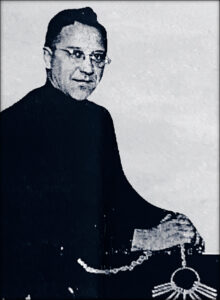
On opening day, the incoming freshmen met in the auditorium. Once we assembled, a wooden “clapper” signaled silence. We settled down as a tall, thin priest in a long black cassock walked down the center aisle and turned and faced us. “I am the prefect of discipline,” he announced. “I am also the assistant headmaster and the prefect of athletics. There is a headmaster, but you will never meet him. In fact, you’ll probably never even see him until you graduate . . . and some of you will never graduate. I run the Prep. And for discipline, I have an assistant who helps me. Let me introduce him to you.” He reached through a slit in his cassock and took out a three-foot window sash chain, at the end of which was a large steel ring, about five inches in diameter. There were a dozen or so heavy silver skeleton keys on the ring. Slowly, he began to twirl the chain, gradually building up speed until it was circling menacingly with a loud buzzing sound. As it twirled, he moved in front of an empty chair close to where I was sitting. With a sudden movement, he let the twirling ring with its heavy keys come crashing down on the chair, leaving a deep scar in the wood. “That is my assistant, gentlemen. Pray to the Blessed Mother that you never meet him any closer than you are now. I can assure you his bite is very deep, and if it could talk, it would tell many a tale.”
If we obeyed the rules, he continued, and brought credit and honor to the Prep in the classroom and on the playing fields, then we would have nothing to fear from him. But if we didn’t. . . . After that threat, he told us that the Prep would be the most important thing in our lives for the next four years, and he would be the most important person at the Prep—more important than our parents or grandparents or anyone else who had authority over us before now. The Prep was going to make strong and successful men of us. Catholic men.
His speech over, he dismissed everyone to their homerooms—except for me. By name, he told me to stay in place, and after everyone left the auditorium, he stood over me, less than two feet away, smelling of cigarettes and alcohol. He took out the chain again and twirled it until it was inches from my face. I was afraid he was going to hit me accidentally, so I backed away. He ordered me not to move.
“I’m not going to hit you, you little Mick. But someday, I can tell, you’re going to do something that will give me an excuse to use this on you. You don’t belong here and I think you know it. You don’t deserve to be in the same room with these other boys. I was against letting you in. I told that bunch of do-gooder trustees not to lower our standards by letting you in. But they did. They want to bring in what they call less fortunate boys. You’re an experiment, and if it works out with you, they’ll be bringing more like you, and then the colored and the Spics who are overrunning our city. You’re a charity case, McCann. An Irish charity case. And you disgust me. Those trustees are going to find out very fast they made a mistake. Now get out of here, you little Irish son of a bitch.”
I was more than frightened. I was terrified. Nobody had ever talked like that to me before, and I never heard priests use that kind of language. In the days that followed, I could not stop trembling as I moved from classroom to classroom and saw him walking the halls and swinging his keys. The halls were narrow, and many of the students, when they saw him, would turn around and take another staircase or flatten themselves against the wall to avoid being hit. In those first days, I also sensed that the other boys were avoiding me. I wondered if some kind of word was out about me. I was different from them, certainly, even my clothes announced that, but I also felt that the other students and most of my teachers had heard I was on his hit list.
One day during my second or third week there, I was in the cafeteria, having just finished my lunch. I was sitting back on the two rear legs of the chair looking at the ceiling (tilting back on chairs has always been a habit of mine). Suddenly, I felt a searing pain in the back of my head. I fell forward and blacked out as my forehead hit the table, and I lay there unconscious for a minute or so. When I regained consciousness, I was covered in blood, and the other boys at the table were looking at me in horror. I had no idea what had happened. My first thought was that a light fixture or a heavy piece of plaster had fallen from the ceiling, but then I saw him swinging his keychain as he walked away. As I realized that he had hit me as he was passing, my pain vanished and I got up and ran toward him as fast as I could, crashing into his back and knocking him to the floor. I punched him as hard and as many times as I could while several of the boys and teachers tried to pull me off him. I pounded and pounded him. His glasses were off, his Roman collar was ripped, and he was sitting on the floor dazed, covered in his blood and mine.
I had given him a bloody nose, he had bitten through his tongue, and some of his teeth were loosened. He was helped to his feet and led from the lunchroom room while I was taken to the nurses’ room and then put into a car to be taken to a doctor a couple of blocks away, to get a two-inch gash in my scalp stitched close. I felt every stitch go in, and eighty years later I still have the scar. Sometimes when I wash my hair or run the comb through it, I can feel sensitivity there. I was not yet thirteen years old. And to this day my blood pressure rises when I think about this sick man, posing as a man of God, and what he did to children.
Nobody saw him for the next couple of weeks. He did not go to his office or say mass or walk the halls or attend athletic events. The word was that he was badly injured and had stitches in his head, but I didn’t believe it. I was out of school only two days. On my first day back, I had the next four months of my life laid out for me by my homeroom teacher, Father Ford. He told me that I would be expelled, but until then I would report every day at 2:35, when school was out, to the “jug,” a subbasement reserved for detention. Each day, on my desk in the jug would be a piece of paper with my assignment for the day, which had to be completed to the prefect’s satisfaction before I could leave the building each night. Father Ford told me that no boy had ever struck a priest in the history of the Prep. I told him in surprising, salty language that if any priest hit me again, I would do exactly the same and hit him back.
Everything changed that day. Father Ford had always been decent to me, and here I was swearing at him. In one fell swoop I went from being an A-plus student to having an F in every subject. And I was in the jug—slang for jail but also, in this context, an acronym for judgment under God. The room was an old closet, about six feet by eight with a frosted glass door and a small transom that could be opened for ventilation. There were no windows. A wooden slab about two feet wide extended from wall to wall. There was no chair, so you had to stand or sit on the floor or bend over and lean on the slab. It must have once been a janitor’s closet; under the wooden slab were capped-off pipes where a slop sink had been.
My assignment on my first day in the jug was on the desk: “Write a 2000-word composition on the subject of a keyhole.” When I was finished, I was to take it to the prefect’s office, slide the assignment under the door, and stand outside the door until the marked-up copy was slid back with additional instructions. A 2000-word composition on a keyhole? Absurd, but I did it. I described what it looked like, how many keyholes there were in an average apartment, and whatever else I could dream up. I carried it to his office and slid it under the door. I waited, and an hour later it was passed back to me under the door, marked “released.” The next night was another 2000 words on the subject of a pinhead. That took me longer to do and it came back to me with two misspellings and a grammatical error noted, so I had to go back to the jug room, find the errors, correct them, and go through the whole routine again.
This went on night after night. I was writing 10,000 words a week, and after two weeks I was exhausted and angry. After a month, for the first time and only time in my life, I felt like killing someone. The subject of being expelled never came up. I think he got more pleasure out of the torture he inflicted on me than if I had been expelled. I remained in the jug for the balance of the term—three more months. I lost my after-school job at a drugstore, and I was always angry, tired, and irritable. I lost weight and got one sore throat or cold after another. On top of my anguish, my parish was always late with my tuition. My report cards went to Father Smith, who must have seen that I was failing every subject. I was constantly hounded by the bursar’s office, which really didn’t matter because the teachers were failing me anyway.
Occasionally, I would see him in the halls swinging his keys. I’m sure he saw me, but he seemed to look right through me. I thought he looked thinner and paler but that could have been my imagination. Meanwhile, the jug assignments grew harder and harder. I did them and never showed any outward signs of wear and tear or anger, but I was getting worse. I suspected that he was also getting angrier and meaner as the weeks went by, and one day he made me write 2500 words about left-handedness—and I was to write it with my left hand. A kid was assigned to watch me and make sure I used my left hand. What he didn’t know was that I started out in life left-handed but was forced to write with my right in first grade.
On the last day of school, students took their annual excursion trip to Jones Beach, but I was not included and had to report to the jug at 9 a.m. I watched as the buses pulled away. I had the school to myself. My assignment for the day was “to rake the track all day and don’t leave until it is perfectly dressed.” I picked up the assignment sheet, tore it in half, and slipped the two halves under the door of his office. I walked to my homeroom and opened my locker and decided that I would leave behind all the books and the ugly teal jacket that my mother had bought from Mr. Mond. There was nothing I wanted to take with me. I walked out the door and hesitated and went back to the locker and retrieved an expensive Rogers Peet tie that a friendly upperclassman had given me, as well as my prose and poetry textbook.
I walked to the main entrance, past the bursar’s office where I had been hounded and humiliated so many times. I walked out the front door and never looked back. I wish I could say that I never thought about that ugly place again, but I did and do still, even more so as I grow older. That place changed me in many ways, probably some that I’m not even aware of. I walked out convinced that my school days were over at age fourteen. I had every intention of quitting high school.
But that was not in the future for me. I would continue my education, though it did take me four and a half years to graduate from high school. And I never again looked upon priests in the same way. One night about twenty years ago, I couldn’t sleep, so I got up and went online. I found myself on the Prep website. I clicked on Our Teachers, and there he was. Remembering those horrible days, I immediately shut down the computer, but after a while I couldn’t resist the urge to return and click on his name. There was a photo of him sitting behind his near empty desk. The window sash chain with its ring of skeleton keys was neatly spread on the desktop. The photo was accompanied by a comment, which said, in part:
Fierce Freddie, universally feared, and even hated by some. I feared and respected him, and as I grew older I realized, with gratitude, how much of my character was molded by his harsh brand of discipline. I remember him walking slowly down the aisle twirling his keychain. As he passed each row, it became silent. By the time he reached the front, you could hear a pin drop. “Stand,” he ordered…and we did.
Who took the picture, I wondered, and why? How did he ever get him to pose for it? Then I realized that he was proud to sit for that photo and pleased to show off his “assistant.” How many kids had felt the sting of it and been marked for life?
I printed a copy of the photo. A year later I went back to the site, and it had been removed. Who removed it? And why? I can only guess at the answers to those questions.