From the beginning of my time with United Fruit—or at least after I moved to the publicity and advertising department in 1952—I took notes and saved newspaper articles and photos and made copies of important company memos. In the beginning I stuffed these documents in my desk drawer. As the collection grew, I created a file. By the time I left the company seventeen years later, I had two five-drawer file cabinets full of corporate documents.
Even as a very young man, I knew I was witnessing history. After the Guatemala coup, I began collecting material relating to other adventures and incidents I witnessed or in which I participated, including the secret help United Fruit gave the government for the Bay of Pigs invasion (Robert Kennedy himself negotiated for the loan of two of our ships to carry men and equipment). I also had material relating to the lock-up of one of our vice presidents who was arrested on a homosexual charge in Boston before the company managed to get it erased from the police blotter, as well as correspondence with an infamous arms dealer, Colonel Herbert Fauntleroy Julian, who wanted to fence millions of dollars in Cuban pesos.
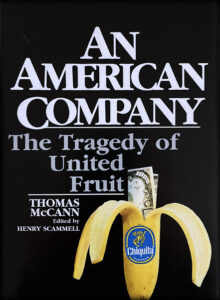
In the beginning, I didn’t know what I would do with these documents, but after a few years I realized that this collection had the makings of a book that thought I might write decades after I retired from the company. After the experience of the Eli Black takeover, however, I began to think in terms of writing it sooner. I wanted to call out Black’s takeover team for what they had done. I was angry, and that anger fueled the writing of a book, entitled An American Company, which was published in 1976.
After I left United Fruit in 1972, I began to organize my thoughts and the mass of material. I decided to dictate the manuscript to get the bulk of it down on paper and then edit it by hand, my usual practice. I dictated chapter one to my secretary. She typed it and gave it back to me. I edited it five or six times, and after a month I had the first chapter. I realized that at the rate I was going it would be years before I had a completed manuscript. So instead of editing as I went, I simply plowed ahead and told my secretary to stack up the pages and not to show them to me until the end.
When we were finished, we had almost 1,200 pages of double-spaced manuscript. I had structured the book so that it ran on three tracks. One track was the recent history of the United States. The second was the story of a young man born in tough times, with no connections, no money, and dismal prospects, who created a successful career for himself. The third track was the story of this fascinating and unique American company.
I showed the manuscript to a couple of Boston agents. Both were enthusiastic. One had worked as an editor at Houghton Mifflin and still had a good contact there. He brought it to her. She read it in one long night and the next day called him and committed to publishing it. Two days later, she called again to say that Houghton Mifflin could never publish the book, as the president was close to George Gardner and another Boston Brahmin. She added that she had even erased the fact that the manuscript was ever logged in at Houghton Mifflin. The only other game in town was Little, Brown, whose president was also George’s friend. The last thing I wanted was an injunction holding up the book. I shifted gears and decided to take it to New York, where we were successful on our first approach. Larry Freundlich at Crown, a young publishing genius, offered a substantial cash advance, contingent on some “heavy editing” and my willingness to be flexible and accept his restructuring. We were in business.
I remained concerned about legal issues, so I showed the unedited manuscript to my longtime attorney Blair Perry, a senior partner at Hale and Dorr. Blair hefted the briefcase holding 1,200 pages and said, “I can’t read this on the clock because you don’t have that kind of money. I’ll take it on vacation next week and read on the beach at Chatham.” A week later he called and said, “How much trouble are you prepared to take?” Well, whatever I needed to rather than risk lawsuits. As a result, a lot of juicy and colorful but litigious material was removed, but there was still plenty of interesting and explosive material left in.
Freundlich, meanwhile, had considered how best to edit this tome. He told me what Crown wanted to buy, and what he felt readers wanted to read—not a book about the recent history of the United States or an account of a young man who had a very interesting career, but a book about United Fruit written by an insider. A “tell-all” book. Or, at least, a “tell-a-lot” book. I abandoned the three-track structure, and we edited the book along the lines Larry suggested.
As I anticipated, An American Company generated some controversy and opposition. Edward Bernays tried to sully my reputation and kill the book by attempting to convince reviewers to ignore it or pan it. A couple of weeks before publication, John Kenneth Galbraith ignored the release date and wrote an extensive review that ran on page one of the New York Review of Books. He said it was “as bad as a book can be and still get published.” United Fruit, he wrote, was an important company that deserved better treatment. He devoted a lot of space to describing the kind of a book he would have liked to have seen written—an expert book, a history book, or a textbook written by a scholar, not an episodic and anecdotal treatment written by a man who started as an office boy.
I was devastated. Crown and Larry were not. They knew that even a bad review by Galbraith meant that it was an important book and would boost library sales. I know now they were right. Happily, scores of other reviewers did not agree with him. The New York Times gave it two reviews, one in the daily paper and another in the book review, saying it was “a remarkable tale . . . compelling . . . very personal, very relevant.” Kirkus called it “hard and cool.” Business Week said, “McCann is an excellent storyteller, and this corporate history is probably as readable as any written,” and the Harvard Business Review described it as “a sensitive though sometimes critical account of the company . . . even non-Bostonians may feel regrets for what happened to this grand old company.”
In one fell swoop, I was a successful published author. Crown continued to support the book with publicity and advertising. I toured several cities and participated in the Annual Authors Night at the National Press Club in Washington. I did a lot of radio and TV as well as bookstore signings. Over the years the book went into several trade paperback editions and was published in many foreign languages, including Japanese and Russian. Most editions used the same artwork as the Crown hardcover, a half-peeled Chiquita banana with hundred-dollar bills in place of the fruit itself.
The Russian edition didn’t have a dust jacket and didn’t include the folio of photographs. They also shrank the overall dimensions of the book and extended the text to the left and right margins as far as they could without going off the page. Yet the Soviet publisher paid me in advance for 50,000 copies and a year later paid for another 50,000. The advance was on the skinny side, so I checked with a friend of mine who was the assistant secretary of state for cultural affairs. He advised me to take the money and not complain. He told me that that the Soviets almost never paid for a book. They just went ahead and printed it. I am still amazed that more than 100,000 Russians were interested in United Fruit.
The book changed my life. I lost friends but gained new ones. Almost fifty years later, hardly a month passes without somebody contacting me about the book. Just recently I was approached by an entertainment law firm in New York inquiring if the stage and film rights to the book were available. In the original manuscript, I opened with that fateful meeting in the president’s room of the Algonquin Club on Commonwealth Avenue, where I would be a member of for fifty years, until it closed not long ago. Often at night, after my guests for the evening had gone, I would sit in that room alone and conjure up that scene that took place there so long ago. It led to the death of the company and to Eli Black’s tragic death as well just a few years later. A tragedy for all.