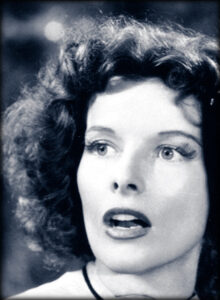
I opened this book with my memory of a never-to-be-forgotten, phone call from Katharine Hepburn more than forty years ago. It was a call that ruined my day. A call that made me angry—with her for her imperious tone, and with myself for thinking that the scenario Bill Gibson and I had written would even remotely interest her.
On that first call, it seemed to me that she went out of her way to be nasty. Yet why was I surprised? Wasn’t this the Katharine Hepburn the whole world knew: spoiled, officious, arrogant? Why should she have been any different with me? Nevertheless, I still felt I should do something to apologize for making her so mad on that cold February morning. By the end of the day, I had decided to send her something—something different, something that she might never have received before.
I called the Nantucket Kite Man, a guy I’d met few years earlier who made custom kites in his shack on Nantucket Wharf. I told him I wanted him to make a kite for a special person. Who? he asked. I was reluctant to tell him, but he finally got it out of me. He said that he had a unique piece of silk from China that he’d been saving for decades, and it was already old when he bought it. It sounded like something that might appeal to Katharine Hepburn, so I commissioned the kite.
Two weeks later, it arrived: six feet tall, with a wingspan of four feet, fashioned with its beautiful fabric and complete with a couple of thousand feet of strong cord. It was indeed unique, like nothing I had seen before. I FedExed it to the Fenwick, Connecticut, house where I had sent the scenario. I included a note, though I don’t remember what it said.
A few days later I got a note back from Hepburn saying, “Nobody ever gave me a kite before.” She said it was “magnificent,” that she had hoisted it to her dining room ceiling, and that she was going to fly it the first windy day. About a month later I received another note. The weather was improving, she wrote, “so why don’t you come down here to Connecticut and help me fly this magnificent creation.” I replied, saying that I was glad she liked it and wished her good luck getting it up in the air.
Another month passed, and another note arrived: “You never said anything about my invitation to come here to Fenwick and help me fly this kite on her maiden voyage.” I thanked her for the invitation but said I was very busy running my business, which took all my time and attention. I had no interest in driving a few hours to meet a difficult woman who, frankly, probably had no interest in meeting me. After all, I thought, we had absolutely nothing in common.
Then out of the blue I got another note, this one asking if my father was “a well-known New York publisher.” There she goes again, I thought, another example of her elitism. I told her that my father was not a successful book publisher but an unknown and highly unsuccessful bookmaker who had been jailed for his exploits. That, I thought, would turn her off once and for all.
But that summer I had to be in Westerly, Rhode Island, for a morning meeting and started to think of her invitation. Perhaps the memory of that first phone call was fading a bit, or perhaps I thought I would get another story out of the visit to add to my collection. I called her and told her of my plans and that I could be in Fenwick by the middle of the afternoon. “Splendid,” she replied, “I’m looking forward to meeting you.” She promised me a “good lunch” and gave me explicit instructions to her house, including the detail that I should ignore the sign in front of her house, which was not for me.
I drove down as invited. The sign she referred to was a hand-painted sheet of plywood leaning against the tree next to her house, which said, in dripping white letters, please go away. I parked my car at the front door and rang the bell. Almost instantly, the door opened wide and I was looking at Katharine Hepburn.
She was shorter than I expected her to be—my guess was five-foot-two. She appeared to be taller in her films. She was dressed in a white turtleneck with sleeves down to her knuckles, too-long chinos, and sneakers. The only skin showing was her face, which bore the white scars of basal cell surgery. She wore no makeup. Her hair was piled high on her head in a twisted bun, her signature hairstyle, which she kept rearranging every hour or so.
She smiled warmly and put out her hand and gave me a very firm handshake. She said she was pleased I was able to make the trip and that it was a pity there was no wind—we would not be flying the kite (though she did say there would be other windy days).
I was carrying a bowl of blueberries Joan had picked that morning from our garden in Rockport, and when she saw them, she said, “I hope those are for me. Blueberries are my favorite!” She dug in. I pulled the bowl away from her, saying, “They haven’t been washed yet,” and she said, “Neither have I—hand them over.” It was a good beginning.
She showed me around her house, which she said was her “favorite place in the whole world.” The living room was full of well-worn furniture, the dining room had the kite hanging from the ceiling, and the kitchen had dirty dishes in the sink and, I noticed, a pile of raw chicken breasts laid out on a wooden board with house flies swarming around it. She led me onto a screened porch, where small tables were set up for our lunch. We were joined by Phyllis Wilbourn, Hepburn’s companion, secretary, and confidante of several decades.
The two of them left me alone for a few minutes and returned with trays of cold fruit soup, grilled cheese and tomato sandwiches on whole wheat, and potato chips and salad. Katharine Hepburn offered me a drink. “I’m a very good drink-maker—I’ve had a lot of practice—and I’ve been told I make the world’s best martini.”
I thanked her and said something to the effect that I could not drink a martini ever again.
“Why?” she said. “Have you had a problem?”
“No problem. I’ve just lost my taste for martinis.”
“Well, that’s good. You’re Irish and Irishmen—and Irish women—have a hell of a tough time with booze. I know that for a fact.”
Without thinking too much about it, I said, “That’s interesting, Miss Hepburn. So Irish people have a special problem with booze. You mean like all Blacks have rhythm and all Jews are cheap and all Italians are in the Mafia?”
She looked at me for a few seconds, her eyes narrowing. I wondered if these were her angry eyes. But she said, “I had that coming. I deserve that. I think we’re going to get along just fine. And no martinis for you.”
When we had finished our lunch, she said, “Now I have a question for you. As you know, I’ve had a very successful career as an actress. Awards. Money. People being extra nice to me. Some flops, but not many. Lately, maybe because I’m getting older, I’ve been wondering how much of my success was due to talent and how much to luck. I’ve been very lucky all my life starting at birth. What do you think? You’ve seen my films. Talent or luck?”
Well, just then I wished I hadn’t turned down that martini. “Miss Hepburn, you really know how to put a guy on the spot.”
Her look told me just to answer the question. I told her that I’d known a lot of intelligent and talented people without luck who had gone nowhere in life. On the other hand, I also knew people with modest talent but very good luck, a combination that carried them through a successful life.
“You are one of the most gifted actresses the world has ever known,” I said, “no doubt about that. You dedicated your life to your craft. You worked hard. You have taken care of your body. You have done all of that and, as you just said, you’ve had a lot of good luck. Your success is because you have both . . . and of course you’ve been in the right place at the right time.”
That was the best I could do. I think I could have done better with more time. However, I had noticed in our conversation to that point that she would nod her head slightly if she agreed with something I’d just said. Those nods helped me to go on. When I was finished, she looked at me and said “Thank you, Mr. McCann. You said a few things that may have helped me.”
Of course, Phyllis had been listening to our exchange and now said to Katharine Hepburn, “I hope that what Mr. McCann said will put an end to that foolish question.” And then she turned to me and said, almost as if Hepburn wasn’t in the room, “You’re not the first person to be asked that question. I wish she would stop.” I had the feeling Phyllis could say anything to Katharine Hepburn.
Hepburn seemed not to hear her and said suddenly, “Why don’t we go outside. It’s such a beautiful day. Phyllis knows I have to get all creamed up when I go in the sun, so she’ll entertain you while I go upstairs and get ready.”
When Phyllis and I were alone, I asked her if Katharine Hepburn often invited strange men she didn’t know to lunch at her house.
“No,” she said. “Never. Even people she does know rarely get invited.”
Katharine Hepburn returned, all creamed up indeed and wearing a floppy hat and carrying a parasol. She had a collection of parasols, and the one she chose that day was the one she used in The African Queen. Phyllis cleared the dishes and disappeared. On the way outside, Hepburn asked, “What did you and Phyllis talk about when I was gone?”
I told her. When she said that Phyllis was correct, that she never invited strangers to lunch, I asked, “Then why me?”
She stopped walking and looked at me and said, “I had a hunch about you. I had a hunch that I would like you. And I do. Do you have hunches, Tom? And do you act on them? You must, because you are Irish and Irishmen—” She stopped in midsentence, and we both laughed as she took me to the cedar loveseat in her garden, where I would spend four of the most memorable hours of my life and would begin to get to know something of the real Katharine Hepburn.
She began by telling me the history of the house her father bought. But soon after we sat down, she started sneezing—short, almost silent sneezes one after another, a dozen or more. I asked her if I could get her a glass of water. She said no. The sneezes continued and I suggest breathing into a brown paper bag, which made her look at me as if I had two heads. Was it the sun cream she’d put on? The chocolates I’d brought? I was really starting to get worried.
Between sneezes she told me that just before I arrived, she’d been digging in her garden when she lost her balance and fell into the sunflowers. Phyllis had brushed the pollen off her shirt, but Hepburn thought there may still be some in her hair. She asked me to take my handkerchief and go through her hair and see if there was some pollen. She tilted her face toward me, and I did what she asked. Her strawberry blonde hair was thinning, and I could clearly see her scalp. I didn’t see any pollen, but as soon as I was finished, the sneezing stopped.
After that moment of unexpected grooming, she spoke at length about her family, mostly her father, an orthopedic surgeon in Hartford. She talked about the Fenwick house and how it was destroyed in the 1938 hurricane; how she rebuilt it against her father’s wishes and paid for the rebuilding. She said her father was also against her spending $30,000 for a townhouse in Manhattan’s Turtle Bay. She talked about Howard Hughes and how they had a few dates and how one day he flew over Fenwick from an airport on Long Island and buzzed her house. She said her father didn’t like Hughes. She described him as a nice guy and not at all as eccentric as he became in later life.
She talked about her career and her favorite movies, about living in Hollywood, about her first and only marriage and how young she had been. Her husband was also “a nice guy” whom she “didn’t deserve” and whom she “set free” after a couple of years so he could live a normal life with someone who loved him and would give him children.
She talked about growing old and how few roles there were for her though she still wanted to work. She talked about finding the script for On Golden Pond and how she pestered the producer Joseph E. Levine to drive down to Baltimore with her to see the play. He hated it and “cursed her out” for making him drive there in a snowstorm. She tried to get it produced for years, but despite her celebrity and box office appeal, she got only refusals. As a last resort she wrote to Jane Fonda, telling her it was a very good script, and there was a part in it for her and for her father, Henry. She didn’t know the Fondas, but they were interested, and in a matter of weeks Jane Fonda had bought the rights and put together the financing. I believe Jane tells a different story of how the script came to her. Whatever the case, the rest is history—On Golden Pond was the second-highest-grossing movie of 1981, and Hepburn and Henry Fonda won Oscars for Best Actress and Best Actor.
On and on she talked. There were times when I felt like she didn’t even know I was there. She was looking out at the ocean. Midway into our four-hour conversation, she mentioned Spencer Tracy and how devastated she had been when he died. She said she thought her life was over and was deeply depressed for many months. I told her I was familiar with depression and asked if she had sought help.
“I don’t believe in psychiatrists,” she said. “Neither did Spence and neither did my father.”
Several months after Tracy’s death, Hepburn’s friend Ruth Gordon and her husband Garson Kanin invited her to spend a few days with them at their house on Martha’s Vineyard. Phyllis packed their bags, including a bunch of scripts, which, Hepburn said, she had no intention of reading. For months she had been unable to read anything. She had trouble falling asleep on the first night and started reading the script on top of the pile. It was The Lion in Winter. She loved it. She woke Phyllis and told her to read it and not to make breakfast until she had read it. Phyllis loved it too.
“I loved me as Eleanor of Aquitaine,” she told me. “Didn’t you love me as Eleanor of Aquitaine, Tom?”
I am not misquoting her. That awkward sentence was precisely what she said, the way she described—to a stranger—this important point in her life.
She spoke of Peter O’Toole, who played Henry II. “I love Peter, I really do, but he is a little crazy and of course he drinks too much. But then again, he is Irish.” She looked at me and laughed. “There I go again. Chalk it up to the habit of a lifetime.”
Making The Lion in Winter, she said, was something she would always be grateful for because it got her out of her depression, and depression is a horrible thing that she only really understood when she experienced it.
At this point, her chauffeur approached us and asked if he would be needed in the next hour. If not, he would like to go for a swim. Once he was in the water, she took me to a small room on the first floor, which she said was his. The room smelled of oil paints. There were dozens of unframed canvasses leaning against the walls, and she started to look through them. I was concerned that he might come back and find her going through his things. She seemed to be looking for something.
After a few minutes of searching, she called to Phyllis, who was in the kitchen. “Phyllis, where is that painting of the penis? The one he showed us the other day? I can’t find it.”
Phyllis appeared in the doorway and said she thought he took it to the art gallery in town.
“Too bad,” Hepburn said. “I wanted to show it to Tom. It doesn’t look like any penis I’ve ever seen—I don’t even know which way is up. I think it was upside down when he showed it to us.”
Hepburn did and said anything she pleased—even to strangers. Her friend and biographer Scott Berg tells the story of catching her going through his suitcase. He walked in on her, and she was completely unfazed at being caught. Our four-hour conversation had many such surprises—and she would continue to surprise me throughout our friendship.
Around five o’clock, I announced I had to be going. I was perhaps a bit abrupt because she said, “Oh, I thought you would stay for dinner. May I ask why you can’t stay?”
I awkwardly said I was afraid I might “wear out my welcome.” That made her feel terrible, she said. Had she said anything to suggest she’d had enough of me? I assured her that was not the case, but she had invited me for lunch and it was getting to be supper time. To be honest, I was thinking of that chicken in the kitchen with the house flies feasting on it, but I said I could stay a little longer, and if I was going to stay, I wanted to get some more comfortable clothes from the trunk of my car.
“Splendid,” she said, “but you should have worn them all day. Just looking at you in that jacket and tie all afternoon was making me hot. May I ask when were you going to change into your casual clothes?”
I told her I planned to pull over to the side of the road after leaving and change into my chinos and short-sleeved shirt. She laughed. “Do that in this neighborhood and you’ll get arrested for indecent exposure.”
I got my change of clothes and followed her upstairs. She pointed at a room and told me I could change there.
“It’s my bedroom,” she said. “When you’re changed, come downstairs and we’ll have ourselves a real drink.”
I knew then that someday I would tell the story of being invited into Katharine Hepburn’s bedroom. Today is that day. I have to say it was by far the messiest bedroom I have ever seen, like a teenager’s bedroom—the bed unmade, clothes strewn on the bed and chairs, the closet doors open, and pairs of sneakers all over the floor. There were combs, hairbrushes, and curlers on the windowsills; books and magazines scattered all over; a telephone on a small table next to the bed beside a photograph of Spencer Tracy. There were more than a dozen opened blue bottles and jars of Nivea cream all over the room, not one with its cap replaced.
I went downstairs, and we had a glass of wine and some cheese and crackers. A young man walked into the room and gave her a hug and kiss on the cheek and said he wanted to say goodbye because he was going back to college early the next morning. She thanked him for coming over and said that she would miss him. When he was gone, she explained that he lived across the way and she had known him from the time he was an infant. They played a lot of tennis together, and she had been able to teach him a few things so that now he was the best player on his college team. Again, I was surprised—that a young neighbor could just walk into the house of this American icon.
After dinner, when it was time for me to go, she told me precisely how to get back to Boston so that I could avoid Providence. As I was about to get in my car, she said, “Tom, I don’t think I have all your numbers. All I have is your office number.”
We returned to the house, and she led me to an old oak desk and pulled out two address books, one marked East in gold and the other West. She opened the East book and turned to the Ms. “Damn,” she said, “not a single space for anything else.” She paused and said, “I know what I’ll do—I’ll put your name and numbers in the inside back cover, where I have the names of all my Boston doctors.” Years later, after she died, those two address books would be auctioned off, along with her other possessions.
What that first day with Katharine Hepburn taught me was that I had been wrong about her. I had based my opinions of her primarily on magazine pieces and on her interviews with Dick Cavett and Barbara Walters, but she was the opposite of the person who appeared on those programs. The real Katharine Hepburn was almost nothing like that. She had great manners, was easy to be with, interested in other people, open, and thoughtful. She was a good listener, empathetic, even humble. Never once, from the time I rang her doorbell that day and through all the years we stayed in touch, did I ever feel I was in the presence of a great movie star. The Katharine Hepburn she chose to show the public was a person of her creation, an act. It must have been hard to be that Katharine Hepburn.
The day after I returned home from my visit to Fenwick, I wrote her a letter thanking her for the memorable visit and gradually saying that the thing I found most interesting about it was that she was nothing like what I expected. I mentioned my expectations from books and magazines and interviews. I tiptoed into the subject of how great it would be if she could write a book that showed the world something of the Katharine Hepburn I had met.
She wrote back saying that she didn’t think people would be interested in that side of her. She said she didn’t think she could write a book. She was not a writer; she wrote like she spoke—“in bits and pieces.” She had discussed the possibility of a book with a friend and neighbor, the famous literary lion Robert Gottlieb, but nothing ever came of their discussion.
I told her “bits and pieces” was a great way of describing how she talked, and if she wrote her stories that way, her voice would come through and readers would know she had written them herself. I even suggested entitling the book Bits and Pieces. She continued to be unconvinced, but I never gave up. I once sent her a dozen ruled yellow pads and a dozen Dixon No. 2 pencils, because I knew that was how she made notes. My gift amused her but did not get results. She sent me the following letter:
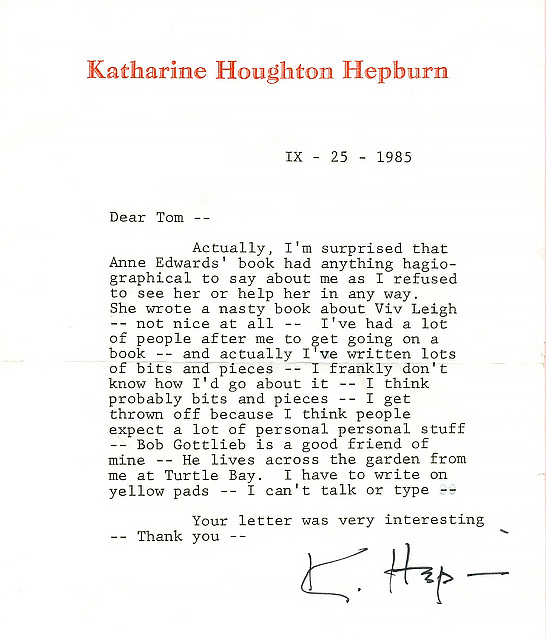
That letter put an end to my urgings. Years later and quite apart from my efforts, at the suggestion of Gottlieb (a difficult, opinionated man) she published a memoir with Knopf entitled Me. That book was the opposite of what I’d suggested. It revealed none of the side of her I had come to know—the good listener who was interested in my life and what I had to say. That was the real Hepburn. I couldn’t finish the book.
Hepburn often said to me, “I think people expect a lot of personal stuff, but they are never going to get it from me.” And they never did. But even though she did not warm to my ideas for a memoir, she did trust my judgment enough to send me film scripts. The first came a couple of months after my first visit. She asked for my opinion, and I gave it to her. She wrote back saying she agreed with me. More scripts followed and I would give her my opinion in a couple of paragraphs. She always said thanks but rarely said whether she agreed with me.
One of the scripts had been written by a young woman who had obviously taken a college course on screenwriting. It had the required number of pages, perfect formatting, and accomplished scene descriptions. She had even included comprehensive camera directions. But the plot was awful, the characters were cardboard, and the dialogue was stilted. I found nothing encouraging to say about it and sent my comments off to her.
A week later the woman sent me the worst letter I’ve ever received from anyone. She wrote I was absolutely wrong about the script, and everything I said was garbage. She blamed me for getting between her and Katharine Hepburn performing in what could have been an award-winning motion picture. She wound up by saying that she was going to church on Sunday to pray to the Lord to strike me down dead, and she intended to sue me for millions.
Angry, I called Hepburn and read the letter to her and told her how upset I was. She had obviously sent the script back to this person with my letter attached. I told her that if she ever did it again, I wouldn’t read another script. There was a moment of silence. Then she said, “Are you finished scolding me, Mr. McCann?” I wondered, what happened to “Tom”? “Listen to me,” she continued, “I agreed with every word you said about that so-called script, and I wanted this woman to see that it was read by someone who is in the business and who himself has written scripts and books and someone whose opinion I value. This is a goddamn tough business and only the tough and talented survive. This woman had to be told the truth about her script.”
She paused. “And as for telling me not to do something—how dare you, sir! If I want to do something, I will do it. Nobody tells Katharine Hepburn what to do. Nobody! Goodbye.” She hung up the phone.
Once again, I was on the receiving end of a nasty phone conversation, though it was not the end of our relationship—within ten minutes she was back on the phone calling me Tom! She continued sending me scripts and asking for my opinion on other matters. But I learned that there was a part of Katharine Hepburn that was very unattractive. Things always had to be her way.
What more to say about this amazing woman? Much, of course, as I knew her for many years, but she was a private person, and I think she knew that I would never violate her trust. In this chapter, I have done just that—written nothing that she would object to. I am certain about that.
Phyllis died in April 1995. Hepburn’s friend Scott Berg called to offer his condolences and to see how she was doing. During the conversation, he asked, “What did she die of?”
“What’s the difference?” Hepburn said. She stopped breathing and she’s dead. And that’s that.” A few weeks later—May 12, which was Hepburn’s eighty-eighth birthday, a few intimate friends gathered at the small cemetery in Fenwick to bury Phyllis’s ashes alongside members of the Hepburn family. It was raining, and Scott said Hepburn dropped to her knees and sobbed. He said he never heard Phyllis’s name again.
Hepburn died eight years later, in June 2003, at Fenwick. The managers of her estate decided that there would be an auction of all her personal property—everything they could get their hands on and everything she ever touched. She had lived to the age of ninety-six protecting her privacy and creating an image that she presented to the world. Now, her life and possessions were being auctioned off to the highest bidders, listed in a 250-page catalog entitled “Property from the Estate of Katharine Hepburn,” from the wedding dress she wore in 1928 when she married Ludlow Ogden Smith to a pair of her tennis shorts, with the notation that they were “soiled.” From a sculpted bust of Spencer Tracy she had done herself to the picture of Tracy I had seen on the table next to her bed. Also listed was a picture of Hepburn, “with no makeup and her hair in rollers,” packets of her correspondence, including letters from me to her, those two leather address books.
In time I got a call from the secretary of the man who bought those address books, with my name and number noted inside the back cover of one of them. The man had noted my name and told her to call me and find out if I was “someone.”
“Tell him you called me and that I am ‘someone’,” I told her.
I think Hepburn would have liked that response.