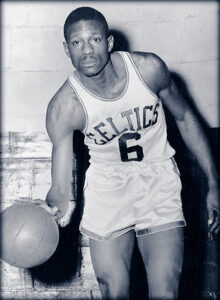
I moved to Boston with United Fruit in 1959, and on my first day on the job I got a call from Sandy Calmas, a Brooklyn native who had set up an organization called “Brooklyn in Boston.” Twice a year, she invited Brooklyn-born people to a cocktail party at the Hotel Bradford. There was a cash bar, light hors d’oeuvres, and a five-dollar charge to cover rental of the room.
I signed up and went to the next event, which was two weeks later. Ahead of me in the line as I checked in was Red Auerbach, head coach of the Boston Celtics, who was then in the middle of his brilliant coaching career. Red was already legendary. He’d won two of what would become nine NBA championships. In 1950, he had drafted Chuck Cooper, the first Black player to play in the NBA. Red was a Brooklyn boy and a genuine character.
Red and I started talking in line and wound up spending most of the night together. We got along so well, he invited me to have dinner with him later that night at the Lenox Hotel, where he kept an apartment. The next day, he called me and asked if I would like to meet Bill Russell, the star of the team. I remember hesitating and telling him, as diplomatically as I could, why I had little or no interest in meeting Russell.
Like most people in Boston, I knew that Russell’s relationship with the press was bad. I told Red I’d heard Russell was moody and difficult (even nasty) and often accused of hating white people. He did not sign autographs, and stories circulating around him rarely had anything good to say about him except as a player.
Red interrupted me, “Tom, no. Don’t believe everything you read. Sure, he’s difficult, but he’s also exceptional, and I have a feeling you two will get along. Bill needs a friend. He’s got lots of friends in name only. But he needs a real friend.”
I agreed to meet him. We had dinner at the Lenox. Bill and I shook hands, and it was the worst handshake I’d ever experienced—weak and longer lasting than most handshakes. Later, after Bill and I became good friends, I asked him about it. He said it was intentional. He said he could tell a lot by the way someone shook his hand. Some men squeezed hard to show him how strong they were. Others couldn’t wait to let go, and Bill would tell them not to worry—the color didn’t come off with a handshake!
That first meeting, Red did most of the talking, and Russell and I mostly listened. Occasionally, Bill looked at me intently, and I guess my handshake must have been fine, because at the end of the dinner he turned to me and said, “We’re on the road for the next eight games, and I’ll be back in twelve days. Would you be interested in having a cup of coffee or maybe even lunch when I get back?”
I said I would, though I never expected to hear from him. Two weeks later I got a call, and he suggested lunch at the Bulkie, a Jewish delicatessen on Boylston Street, right across from my office. He liked the food there and he liked the owner, Papa David, who owned a Rolls Royce and let Bill drive it on occasion. Papa met us when we arrived and seated us in an alcove close to the kitchen, at what was known as Papa’s table, reserved for special guests.
I don’t remember much of what we talked about. It was just a getting-to-know-you lunch. I do remember Bill telling me that he thought basketball was a child’s game. That he was in the “entertainment business.” It was not what he was meant to do for the rest of his life, but the money was good, and it was something he could do until he decided what to do afterwards. He also recognized that Boston was one of the most racist cities in the country.
In the weeks that followed, we saw quite a lot of each other. Little by little, Bill told me what his life was like, including examples of the racism of the time. He told me that Bob Cousy, a Celtic legend who was just a couple of years away from retirement, had been paid to sign the official basketball of the NBA. When Cousy retired, the manufacturer asked Bill to sign the same ball and offered him $5,000. Bill asked Cousy how much he got for the endorsement, and Bob told him that it was $10,000. That ended the discussion with the manufacturer. Bill knew that his treatment was based on his race. And he knew that treatment was in line with the racist catcalls he heard from the stands in cities throughout the NBA.
However, the Celtics paid Bill well by the standards of the time. In 1965, he became the first NBA player to be paid $100,000. So he had money to invest. And he always had an eye out for what he thought might be good investments. All of them turned out to be wrong. He made a deal with Firestone Rubber, for example, whereby he would own a rubber plantation in Liberia named after him. That turned out to be bad investment, his first major financial loss.
Then there was Slade’s, a restaurant in Roxbury he owned. One day he came to me with a sheaf of handwritten pages with hundreds of numbers on them, allegedly the restaurant’s financials. One look at those numbers and I could see Slade’s was a disaster. Instead of earning a profit of $2,000 a month, which its bookkeeper claimed was the case, he discovered that the place was losing that and more each month.
Soon afterward, Bill slid into a booth at Slade’s one lunchtime looking worried. One of the waitresses, Tootsie, sat down and asked him what was wrong. He told her how the place was showing a loss. How could that be? Business looked good. She told him bluntly that employees were stealing from him.
“Who’s stealing from me?” he asked.
“Well, the bartenders, the cooks, the wait staff, the receiver . . . and me.”
Bill was shocked. He sold Slade’s at a loss a few months later. But he appreciated Tootsie’s honesty and the two went on to become lifelong friends.
Bill just wasn’t good with money. He lived an extravagant lifestyle beyond his means; some years, he spent almost twice his annual salary. But he was an amazing man—one of the most intelligent men I have ever known, a man of tremendous energy, with a wicked sense of humor, a preoccupation with dignity, and a capacity for great friendship. He was generous, considerate, and trusting—and often inconsiderate and distrusting.
But a great friend. The friendship we forged, almost from the beginning, was one of the strongest I’ve ever had. Bill felt the same way. We shared many traits. We were the exact same age—he was born three weeks ahead of me. We were both left-handed but did some things righty. Both introverted but thrust into positions better suited to extroverts. We both married high school or college sweethearts and had children of the same age. We both lived in Boston during the eventful 1960s and were searching for what we really wanted to do in life.
Bill’s life was infinitely more complicated than mine. He knew he was different. He liked to point out that he was Black, left-handed, and almost seven feet tall. Needless to say, he stood out. He did not trust most white people, and with good reason. He was a soft touch, and there were always people around who wanted something from him, whether it was an autograph, tickets to a game, or money. Knowing him was a sort of education, and I was fortunate to have had nine years of almost daily contact with him.
My friendship with Bill gave me insights into race that most white people didn’t have. In the sixties there was a lot of racial unrest, with protests and riots throughout the country. One morning, Bill called me early and said he’d just had a call from the actor and former NFL star Jim Brown, who wanted him to go to New York that morning for a speech at Harlem High School about a Black economic union that Brown was promoting. Bill asked me if I would like to go down with him and from there go on to K.C. Jones’s summer camp in upstate New York. I agreed.
We took the eight a.m. Eastern shuttle to New York, jumped in a cab, and told the driver we were going to Harlem High.
“Not in this cab, you’re not,” he said. He could get us close enough, he added, but it was a dangerous place to go. He dropped us on the outskirts of Harlem, and we walked toward the high school. As we walked, we saw a cluster of Black youth on the upcoming corner.
“Do you think we’re in trouble?” I asked Bill.
“We could be.”
I remember saying, “Maybe you should hold my hand.”
He said, “Who’s going to hold my hand?”
As we got closer to the corner, one guy said, “Hey, it’s Big Bill Russell. Come over here, Bill.”
We spent the next ten minutes chatting with this group of peaceful guys who then walked us to Harlem High. An hour and a half later, a Black cabbie took us back to the airport.
Bill could be complicated on the issue of race. In 1969, I talked United Fruit into establishing a foundation that would send outstanding basketball, soccer, baseball, and track and field athletes and coaches to five countries in Central America where we grew bananas. Red Auerbach helped me form a sports advisory committee for the foundation that included Bill and Jesse Owens, who enraged Hitler by winning three gold medals at the 1936 Olympics in Berlin.
Bill told me that Jesse was an “Uncle Tom” because he did so much business with American companies, from Ford to Swanson. I became very close to Jesse and discussed this with him at length. Jesse told me, “I don’t give a damn what Bill Russell thinks of me. He didn’t have the same experiences I had in Berlin. He has no idea how, when I came back, I had to find work running against racehorses and a motorcycle and traveling with Negro League baseball teams as an added attraction. How I had to go miles out of town just to find a hotel that would accept Blacks. So I don’t care what Bill Russell thinks about me.”
My friendship with Bill led me to become friends with K.C. Jones, a Celtics teammate and Bill’s best friend. They had both attended the University of San Francisco and represented the US in the 1956 Olympics. I got to know K.C. well just as I got to know Bill’s wife, Rose, who he married right after leaving college.
To be invited to the Russell house on Christmas Eve was a memorable experience. Celtics players and close friends of the family were there, and Rose spent a lot of time selecting a different gift for each invitee. Rose was intelligent, beautiful, talented, and devoted to Bill and her children. She was a great mother, wife, and friend. Bill also got to know my family, but my friends were mostly white, and Bill was very frank about not liking white people, especially white men, based on his experience. Throughout my long friendship with Bill, he had only two other white friends in Boston—a lumber salesman at Grossman’s and a man who owned a record shop.
After a while, when Red Auerbach saw how close Bill and I had become, he started asking me to talk to Bill about certain things. One summer BMW gave Bill a powerful motorcycle, which they hoped would promote US sales. After trying to talk Bill out of riding the bike, Red asked me to try. Of course, I refused. That was not what friends do. Red also suggested that I ask Bill to practice more. Can you imagine, Red told me, how much greater Bill would be if he would practice, even just a little? Again, I refused. After a while Red got the message and stopped asking me.
After setting up the foundation at United Fruit, I planned a five-city tour of Central American capitals to announce the program. My boss, Jack Fox, president of the company, agreed to come on the tour with Bill, K.C., and me. We took the company plane and hit a different capital each day, calling on the president of each country and meeting with the press and people in the sports world.
It was an interesting trip. In Honduras, where we began, the president greeted us warmly and said, “At last we have somebody tall enough to change the light bulbs!” On to another country, where the president asked us if we knew any dirty jokes. When we got to Panama, the president had been holed up in his office for two weeks. Outside his building, there were howitzers, machine guns, and sandbags up to his office window. We couldn’t wait to get out of there.
In Tegucigalpa, Honduras, Bill and I had to share a hotel room. We were lucky to get it. There was something going on with the government, and the city was full of foreign press people, soldiers, and police from all over the country. Many Americans were there, trying to leave the country on one of the few flights out.
There are not many hotel rooms in Tegucigalpa to begin with, and those that are there have short mattresses to suit the locals. So Bill’s feet dangled almost a foot over the end of the bed. It was the first time I had ever seen his feet. I was shocked and couldn’t help commenting. I’d never seen feet like that: totally flat, spread out, with no arch and toes that were bent out of alignment. Bill was amused when I put a bright light on them for a closer look.
“Watch me wiggle my toes,” he said, and it seemed to me that half of them didn’t move at all. He said his flat feet were the result of years of running up and down the basketball court, playing and practicing. He agreed that with feet like that it was amazing that he could still jump as high as he had in high school and college.
The broken toes happened at least a few times each season, but the Celtics never announced the injuries because players on opposing teams would intentionally step on his toes if they knew. He said he never lost a day because of a broken toe. After the game the trainer took care of it. He also broke a lot of fingers that had to be put in splints and taped together, sometimes on both hands. There are lots of photos of the fingers but none of the toes. He told me a podiatrist once said to him, “Bill, you have the feet of an eighty-year-old man. No, correct that. I have never seen feet like yours anywhere on anybody, and I have been doing this work for a lot of years.”
In Nicaragua, we were supposed to meet with President Somoza in the late afternoon. When we arrived, we discovered it was the night of the presidential ball, and the president said he would see us in the morning. Somoza assigned a colonel to look after us. The colonel’s idea of a pleasant evening was to take us to what he said was the best whorehouse in Managua. None of us—Bill, Jack Fox, K.C., and I—were interested, but so as not to offend the colonel, we had a drink in the reception area. A Jamaican woman, nearly as tall as Bill, and missing a front tooth, decided to make a play for him. He wasn’t interested in the slightest, and she wound up bouncing a shot glass off his million-dollar elbow and had to be removed.
The next morning, the colonel took us to President Somoza’s “ranch” on a mountain outside of Managua for breakfast. When we got there, we were surprised to see four howitzers aligned with the cardinal points of the compass. There were sandbag structures and two helicopters, one of which always had its engine running to ensure a quick getaway. Somoza was very affable. He knew Jack Fox from negotiations, and he owned a major share in every activity in the country. He regaled us with stories, from his youth in Brooklyn, military school on Long Island, and his time at West Point, to dealing with Howard Hughes.
From Nicaragua, we went on to Costa Rica. Bill had done some reading of our annual reports and learned that United Fruit was involved in the growing and refining of African palm oil. He asked if we could tour the plantation, much to the displeasure of our chief pilot. Nothing came of Bill’s fascination with African palm oil, but he was serious enough to ask me to explore the possibility of him taking a job at United Fruit to learn the business.
That Central America trip was one of many adventures I had with Bill. A lot of them had to do with cars—one of his obsessions. One summer morning, I got a call from him at 11:30 saying he was in Providence, Rhode Island, where he’d just taken possession of a new Lamborghini, which cost $15,000 ($150,000 in today’s money). He asked if I was free for lunch and said he would pick me up on the Huntington Avenue side of the Prudential at about noon. I figured there was no way he would get from Providence to Boston in half an hour, but I went to the appointed spot on time and there he was, waiting for me. Fifty miles in a half an hour. Do the math.
I got in. He went a couple of blocks up to Mass Ave., made a right turn and a quick left, and we were on the Mass Turnpike. When Bill drove, he didn’t like anyone to speak to him, and he usually wore driving gloves. We peeled off about a mile or two very quickly and all of a sudden there were toll booths in front of us.
He said, “We can’t stop . . . we’re not stopping.”
We went right through the toll booths. We got off at the next exit and got away with it.
One night Bill was coming home from a game at around two a.m. On Route 128 he decided to see how fast the car would go. He had it well over 80 mph when he saw the blue light in his rear mirror. He pulled over. When the state trooper realized who was driving, he told Bill to slow down and asked him if he knew how fast he was going.
“About 90?” Bill said.
“Exactly 90.”
“I was trying to see how fast my new car can go.”
“OK. Are you in town this time tomorrow night?”
“Yes, I am.”
“Meet me here, Bill. We’ll close down an exit or two for you so you can really let it out. Then we’ll have some coffee and donuts.”
Sure enough, the following night, they closed down three exits in both directions, and Bill hit 115 mph. Twenty-five troopers showed up for coffee, and Bill spent about an hour and a half with them.
Bill didn’t mind staying up late. And unlike many athletes of today, he was a smoker, as I was. The day the Surgeon General’s report on the dangers of cigarette smoking came out, Bill and I were having lunch at the Bulkie. We talked about the report and agreed we should quit. So, that day, Bill and I agreed we would both go cold turkey.
On our way out of the restaurant, I stopped at the cigarette machine and plugged in a quarter and dime and pulled the lever for a pack of Luckies. Bill turned to me and said, “What the hell? I thought we just agreed that we are going to quit!”
“Yes, we did,” I said, “but I’ve quit several times before, and if I wake up at two in the morning and want a cigarette, I’ll know that there’s an unopened pack in my top sock drawer.”
Bill thought that was stupid and said so. Two weeks later, he called me.
“Guess what?” he said. “Last night, I woke up and wanted a cigarette and there wasn’t anything in the house.”
In those days there were no convenience stores, and by the time he woke the bars were closed. He knew he’d have had to wait until morning. But not Bill. He got in his Lamborghini and went searching for someplace that was open. After driving around for a while he wound up back at his local gas station in Reading. He got out, popped the trunk of his car, took out the tire iron, and was about to smash the station’s glass door to get at the cigarette machine when he suddenly realized what he was doing. He dropped the tire iron, returned home, and finally fell asleep.
In the morning, he realized he’d left the tire iron behind. He called the gas station.
“I found it,” the station owner said.
“Well, it’s mine and I’ll pick it up in an hour or so.”
“What’s it doing here, Bill?”
Bill said, “You wouldn’t believe me if I told you.”
Bill also loved to drive my car, a 1968 Saab. The driver’s seat was positioned a little off center and gave him extra leg room. He also liked how freewheeling it was. Anytime he had to go a long distance, like K.C.’s camp up at the Canadian border, he would take my car and leave the Lamborghini for me to drive. Not that I was pleased—I didn’t enjoy its rough ride and how low it was to the road. Also, I was afraid of scratching it in the parking garage!
Driving fast gave Bill an outlet for his stress. As the best player on the best basketball team in the world, he was expected to succeed, year in, year out. That stress increased after the 1966–67 season, when the Celtics won their eighth straight NBA championship. After that season, Red Auerbach retired as head coach, and Bill was chosen to replace him—and he continued to play as well. He was the first Black head coach in NBA history.
Being a player-coach was a heavy burden. The part of the job he hated most was cutting talented kids at the beginning of each season to get the roster down to its allotted number. He agonized over this for weeks. He knew that for many of them, their dream job in the NBA would never happen, and it would affect their lives forever.
Red stayed with the Celtics as general manager, and when Bill became coach, he asked Red for an office. Red refused to give him one and instead suggested that anytime Bill wanted to make a personal phone call or open his mail, he could use Red’s office and stay there as long as he wanted. I was there when that conversation took place. A few years later, when Tom Heinsohn succeeded Bill as head coach, Red gave Heinsohn his own office. That hurt.
I fault Celtics owners for neglecting their players in an important way. Most of them were underpaid at the time, and ownership and management failed to give them the financial advice they needed to handle their money and keep from making mistakes. They should have advised players on saving, investing wisely, and managing their money. Most of them had to work in the off-season selling everything from insurance to automobiles.
As a player-coach, Bill had to juggle his professional responsibility with his team friendships, formed over many years of intense competition and time together. As I’ve mentioned, Bill was particularly close to K.C. Jones, going back to college days, but there was also another Jones on the team that Bill was very close to—Sam Jones.
Bill had enormous respect for Sam, as a player and as a man. There was a side to Sam that amazed Bill. He told me about an incident that happened in Philadelphia, for example, that had quite an effect on Bill. The Celtics were matched with the 76ers in a crucial playoff series in Philadelphia. One night Bill returned late to his hotel from being out and there was a loud knock on his door. He opened it and there was Sam, standing in his underwear.
“Let me in, Russell,” he said. He came in and said, “Bill, we’ve got a big game tomorrow, and you’ve got to be really up for it. You’ve got to play the best game of your life because I’m not going to be able to do anything they tell me.”
“Who tells you, Sam?”
“They tell me. That’s all you’ve got to know. And they tell me, if you win the game tomorrow, I’ll win the game on Saturday when we get back to Boston.”
“OK, Sam, OK. I’ll do that.”
Sam returned to his room in his underwear, and Bill went to sleep and forgot all about the visit. The next afternoon, as they were suiting up, Sam winked at Bill. That game, Bill set records for rebounds, block shots, assists, and even scoring. It was one of the best games of his life.
A couple of days later, the team was back in Boston. Sam winked at him again and said, “Russell, I told you that if you won that last game, I would win this one. Watch me.”
That game, Sam was on fire. He set playoff records of his own and was the star of the game. Along with Bill and K.C., Sam was the only Celtics player to be part of the team’s eight consecutive championships from 1959 to 1967. He was known as “Mr. Clutch” for his ability to perform well when everything was on the line. Bill never did figure out who had “told” Sam who would be the stars of those two playoff games.
Bill’s first year as player-coach ended with a loss to Philadelphia in the playoffs, but the following season he brought the team back to the pinnacle when they beat the Los Angeles Lakers 4–2 in the NBA Finals. A few months later, I was home with the flu when Bill called and said he had just been named Sportsman of the Year by Sports Illustrated. He was very excited about this award because it said that he was more than just a basketball player.
Bill was able to invite three people to sit at the head table at the awards ceremony at the Harvard Club on Commonwealth Avenue in Boston. I told him I was sick. He said, “Listen, Jimmy Brown is coming in from LA on the redeye, you can come in from your sick bed in Walpole.” So I did. As I approached the entry of the Harvard Club, Jim Brown was getting out of a taxi. He had flown all night to be there for Bill. He was at the head table, along with K.C. and me.
The next season would also end in a championship for the Russell-coached Celtics. It had been a challenging regular season, with the Celtics finishing fourth in their division. But they managed to get through the playoff to the finals and again defeat the Lakers, their long-standing rivals. Bill was hurting. He told me at the beginning of the season that he dreaded going up and down the court thousands of times. He was thinking about retirement, even though he was under contract to play to 1970.
After the Celtics’ victory, the city of Boston erupted. The city fathers decided, for the first time, to have a parade for the Celtics. The morning of the parade, Bill called me and said, “I hope you’re not having lunch with somebody today.” I said I wasn’t, and he said, “I’ll be at your office at about 11:30 and I’ll bring the lunch.”
He came into my office with two bags of food from Bulkie. Down below, I could see the parade forming in front of the Hynes Auditorium. The parade route was up Boylston Street, which was lined with fans. Bill pulled out the leaf on my desk and opened the bags of hot pastrami sandwiches, potato salad, pickles, French fries, and soft drinks. We ate. I could see he was tense.
At one point I said, “Bill, I think you should be heading out for the parade.”
“What parade?”
“The parade that’s forming outside the window here. Twenty-eight floors below us.”
“I’m not going to any parade.”
That’s all that was said about the parade. He stayed through the lunch, and I got a call to attend an emergency management committee meeting on the floor above. When I returned from the meeting, he was still there, asleep on my couch. By the time he woke up, the parade had long since passed.
That’s when he told me he was leaving Boston for good, and he was not going to fulfill his contract to play another year. If he had delayed his retirement by just a few more months, the Celtics would have had to pay him $50,000. He could have used the money, but he didn’t operate that way.
I knew his financial condition. He owed money. He had continued to spend more than he earned. There were problems with the IRS, and he was short of cash. He told me he was leaving—driving—the following night for LA. He was going to live with Jim Brown for a while. After thirteen years and eleven NBA championships, he was leaving town with a thousand dollars of borrowed money in his pocket, a broken marriage, kids he loved, debts, and more. Yet he remained optimistic. He was going to start a new career and a new life. He was finished with the game of basketball, which, as I mentioned before, he regarded as a child’s game. He still considered himself an entertainer.
Almost everything written about Bill at the end of his career with the Celtics asked the questions: Why wasn’t he at the parade? Where was he during the parade?
He was not at the parade because he did not feel that he wanted to do anything for the city of Boston. And he was with me, for lunch and most of the afternoon.
Less than four days later he called me from Jim Brown’s apartment, where he had just arrived after driving almost a thousand miles a day. He stayed with Brown a week or so and then found an apartment. Books about Bill have said that he spent part of the parade day morning with Red. Years later, I asked him if he saw Red that day. He had not. If he had spent any time with Red, he would have had to tell him that he was not playing another season.
My work took me to LA on occasion, and I saw Bill several times while he was there. He had changed. At lunch or dinner in Boston, he would not look left or right, up or down. If someone came over to the table, he would just ignore them. But in LA, it was a different story. He took me to an exclusive place called the Steak Pit. You had to be “someone” to get in there, and he certainly was someone. As we waited for our food, Bill whispered, “Do you see who’s sitting next to you?” I looked. It was a guy with long hair and an attractive woman with him. It was Neil Diamond. I was familiar with a couple of his songs but had never paid any attention to what he looked like. Bill said, “I knew this place would be lost on you.”
Five minutes later he said, “I bet you know the guy who just walked in the door and is waiting to be seated.” I turned around, and it was Rock Hudson. Bill was right. I did recognize him.
Bill had hoped to develop a film career in LA, but it never panned out. In 1973 he became head coach of the Seattle Supersonics (he also owned a piece of the team). Whenever I was in town Bill and I would get together and do a couple of things in the time we had allotted. One morning on a trip to Seattle, I met him for breakfast in the lobby of the hotel where I was staying. As I headed toward the dining room, he said. “No, I’m going to take you to the best breakfast in Seattle.” He drove me to a Holiday Inn on the poor side of town, and the waitress, Mildred, greeted him. He knew her by name.
She said, “Are you gonna have the usual, Bill?”
“Yep, the usual.”
“Six eggs over easy, two orders of bacon, one order of fries, and no bread.”
“That’s it!”
“Bill, honey,” she said, “don’t you worry about cholesterol?”
“No, Mildred, I’m taking it all with me!” he said, letting out a big laugh.
That was Bill as I like to remember him. As the years passed, our contact was less frequent. We still talked on the phone, and when Bill came to Boston we would get usually together—and the space between us disappeared. But we saw each less and less. There was the long distance between Boston and Seattle, but health problems and other interests took a toll on our relationship. I also had the feeling his mail and his phone were being screened, but I’m not going to speculate about that. K.C. told me he felt the same way.
He was proud of his children. Bill Jr. was his first, and Bill nicknamed him Buddha because he had a fat belly as an infant. He died a few years ago. His other son, Jacob, is an artist and engineer in Seattle. His daughter, Karen, is a Harvard-trained lawyer who has kept up her father’s tradition of advocating for civil rights. Bill was very proud of her. In between practicing law and reporting for CNN, she moved back to Seattle to help her dad preserve and enhance his legacy and manage his finances. His life and bank account always improved when Karen came on the scene.
The last time I saw Bill was in Hartford, Connecticut, where he was filming a show for public television with, among others, the jazz critic Stanley Crouch and the filmmaker Spike Lee. I stayed at K.C.’s house. Bob Cousy and his wife, Missie, were also there, and so was Bill’s third wife, Marilyn Nault. That night, Bill was sitting at a table with Marilyn and others involved in the show. He just planted himself there and never came over to the table where his old teammates and I were seated. I spoke to Bill a few times after that, but our old magic hadn’t survived the physical distances between us.
When Bill died, there was no cause of death given. There was talk of a stroke or strokes, talk of dementia, of kidney failure. According to the Boston Globe, the death certificate listed some sort of a breathing problem. It would be very much like Bill to request his survivors not to reveal what caused his death. My guess is that there is a written document somewhere and his fourth wife, Jeannine, is simply carrying out his wishes.
Anyway, what does it matter what he died from? It doesn’t.
What matters is that Bill Russell lived, and his record is there for all to see. That’s what matters.