On a Saturday night in September 1987, I drove from Rockport to our Boston apartment, where I changed into my tuxedo before rushing over to the Algonquin Club for a Beacon Society of Boston night. The society, formed a hundred years earlier, maintained a membership of about a hundred members and held six such events a year. Each member was expected to bring a guest or two, so that there were usually between a hundred and fifty and two hundred in attendance.
The society and its events had a colorful history and left a legacy of many good stories—not all of which are repeatable. And some of which were sad. After one event, the wife of a member called into the club at one in the morning. Her husband hadn’t returned home, and she was worried; he was always home by midnight. She had called the Boston Cab Company, which he always used, and it had no record of him. The night doorman of the club called his counterpart, who had left the club at 12:30. He had a distinct memory of putting him a cab shortly after midnight. The wife then called the Boston Police, who sent a detective to the house, interviewed the doorman, double-checked cab companies, and contacted the hospitals. No sign of the guy. So the police put out a missing persons bulletin.
All day Sunday, the man’s his family waited, searched, and worried. The Algonquin was closed on Sundays. On Monday morning a housekeeper at the club found his body in a dark corner of the reading room. He had never left the club. There was a half-empty glass of Scotch in one hand and a cigar in the other. The cigar had a six-inch ash in one piece, indicating to the police that he had died peacefully in his sleep without any kind of a struggle.
On another night, there would be no such sadness, but there would be some drama. At least for me. Keep in mind that these events were for the benefit of Boston’s most privileged. They were lavish. No expense was spared. The cocktail hour served top-shelf liquor and a lot of it. There were heavy hors d’oeuvres: oysters, shrimp, mini lamb chops, steak tartare, and plenty of Beluga caviar. Dinner usually started with turtle soup, followed by several courses of the finest food, cooked to perfection in the kitchen of our world-famous club and served by its professional staff.
The president of the society sat at the head table, beside the guest of honor and several movers and shakers from Boston’s elite. After the meal, but before coffee and dessert, a choral group from a local women’s college—the Wellesley Widows or the Wheaton Wheatones, for example—entertained the dinner guests. Then eight-inch cigars—the most expensive money could buy—were distributed as were cigar clippers, one per table. We clipped, we lit up. Even those who never smoked cigars partook, and the room quickly filled with smoke as the guest speaker was introduced. After he spoke and took a few questions, it would be close to midnight. Everyone went down to the second-floor bar and grille room for more drinks, billiards, darts, and tall stories.
It was a very male event. The speakers were prominent men, from presidents and senators to ambassadors and secretaries of state to leading sports figures. In my time as a Beacon member, a lot of military men addressed the society, including General George Patton III, son of “Old Blood and Guts,” and Charles Sweeney, who piloted the plane that dropped the atomic bomb on Nagasaki.
That night, before heading into what was left of the cocktail hour, I stopped at the third-floor bathroom. It had three urinals. The urinal closest to the door was being addressed by a man also wearing a tuxedo. I took the urinal at the other end, leaving the middle one vacant—which is what men do. What we also do is look straight ahead and stay silent. As soon as I’d positioned myself, the man at the other end said in a loud voice, “It gets harder as you get older. I mean harder to piss.”
The voice sounded familiar, but I didn’t respond. The voice then said, “How old are you?”
I told him I was a bit past fifty. He told me he was about a decade older, and that I would find that thing change once you hit sixty. Again, I thought I recognized the voice, but I could not place it.
“What’s your name?” he asked.
“Tom McCann.”
“Don’t tell me you’re the famous shoe man, because if you are, I’ll tell you that I had to wear them when I was a kid and they were absolutely the worst shoes. Cardboard soles.”
I assured him I was not that Thom McAn, and I agreed with him about the shoes because I too had worn them. I added that, on average, one person a week asked me that question, and I had thought I was going to get through this week without having to answer it. He was not amused by my attempt at humor.
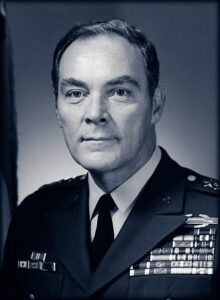
All this conversation happened while we were completing our business, staring straight ahead. I finished first and went over to the sink to wash my hands. A minute or so later he came over to the second sink. We dried our hands and he turned to face me and extended his hand. It was then I discovered that I was shaking hands and looking into the face of Alexander Haig, old warhorse, adviser to presidents, former secretary of state, and one-time supreme allied commander of NATO.
He smiled and asked me what I did for a living. I told him that in act one of my career, I had worked for a big company but now I was a small business owner. He asked what my business was. I told him I’d started Commonwealth Films. He asked what kind of films we made, and I told him that the mainstay of our business was a line of legal compliance videos that helped keep corporate America in line with antitrust, environmental compliance, and product liability legislation. He asked if I was a lawyer and before I could answer he said he didn’t like lawyers. Then he asked if legal compliance videos were the only films I produced, and I told him that we did an occasional docudrama for broadcast TV and even less often a TV movie of the week. He said that he did not like television producers and did not watch television. He said above all he hated television news people.
Our conversation was edging close to a sensitive subject. Next, he asked specifically what programs I’d produced.
I decided to grab the bull by the horns. “General Haig,” I said, “I might as well ’fess up to the fact that during Watergate I was the producer of The White House Transcripts, a reenactment of portions of the Nixon tapes.”
His face darkened immediately, and his smile turned into a snarl. “I know exactly who you are now. As a result of what you did, the White House petitioned the Supreme Court to prohibit the release of any more of the tapes. We even went so far as to request that they make it a crime for anyone else to do what you did. To hire a bunch of actors who looked like the president and his staff. What you did made our job in the White House a lot harder, and I have a feeling that it pleases you to hear me say that. You guys disgust me.”
As he spoke, he was poking me in the shoulder with his index finger. I got defensive.
“I’m sorry about that, General,” I said, “but the program got a lot of nice letters. It won awards and got rave reviews. And Dan Rather sent me a nice letter. He was a White House correspondent.”
That was precisely the wrong thing to say. He exploded. “What makes you think I would give a shit about what TV reviewers or Dan Rather think?”
His repeated poking had begun to hurt, but what bothered me most was that he was the guest speaker for the evening, and I realized I had become the guy responsible for putting him in a very foul mood. Cooling down, I said, “General Haig, you’re making me nervous. I don’t want to be responsible for putting you in a bad mood, and I think I have.” I told him there were a couple hundred men in the next room who were eager to hear what he had to say. People who respected him for the job he did serving our country in Korea and Vietnam and as a member of several presidential administrations.
He looked at me for what seemed like a long time. Then he seemed to relax and said, “You know what, Mac, you’re right. Let’s go in and have some good food, drinks, and some fun.” I told him that would make me happy, and we left the men’s room and headed into dinner.
On the way in, I asked how he liked to be addressed, as General, Mr. Secretary, Mr. Ambassador, or what?
“Mac, most of my friends call me Al, and tonight we’re all friends here, so you can call me Al.”
I explained I couldn’t do that because of the way I was trained.
He looked at me and nodded. “Understood,” he said. “Me too. I could never call my superiors by their first names. Nixon told me to call him ‘Dick.’ I couldn’t. Not that he was my superior, but he was the president. Even after he resigned, I called him Mr. President.” He paused and then added, “I hope the next time we meet, you’ll be able to call me Mr. President. That’s what this evening is all about.
As you know, I’m running for the Republican nomination, and I understand there is a lot of money in this room tonight. I hope to leave with some of it.”
We entered the dining room, and as we were walking he asked me if I was sitting on the dais. I said I was not. I was at table number 12. He told me he’d walk me there. When we got to the table, he said, “Tom, introduce me to your friends.” The others at the table were shocked, and when he left, they wanted to know how long we’d known one another and how we’d come to be so close.
After dinner, Haig tapped on his water glass with his spoon and walked up to the podium. He said how happy he was to be there and thanked everyone for coming and bringing their checkbooks. He said he was surprised that members of the fourth estate were there, so he planned to be very careful about what he said. Puzzled, the audience looked around the room. There were never any journalists at these meetings—in fact, there was a rule against it. And I certainly wasn’t a member of the fourth estate, though that was the way Haig chose to see me.
He performed well. He was a very good speaker, and the audience liked warriors. He took some questions. Gave good answers. No equivocations. At the end of the Q & A session, someone asked if he would comment on his “I am in charge here” comment the day Ronald Reagan was shot.
He warmed to the question at once. “I’ll tell you exactly what happened,” he said. “I was at my desk at State when I got the word that the president was down and it was serious. I didn’t even stop to throw on my jacket. I dashed down the stairs, not even waiting for the elevator. There was a car in front of the State Department building and I commandeered it. Never did find out who it belonged to. Drove over to the White House at breakneck speed, through lights, swerving around traffic cops. Didn’t stop at the White House guard booth and went straight to the Oval Office. Calmed everyone down. Had a bunch of microphones in my face. I was answering dozens of rapid-fire questions. The cameras were rolling.
“When it was over, our friends in the fourth estate did me in. They edited that tape and focused on one-five word comment I made. They took what I said out of context. The fourth estate! God bless them! That’s the true story of my ‘I’m in charge here’ comment.”
The room erupted in applause for his words. Of course, those words were a lie. There had been no editing. The comment had not been taken out of context. It was a live feed. But that night he got away with his version. I might not have been the only person in the room who knew it was a lie, but none of us were going to say it was.
At the end of the evening, Haig came up to me and asked, “How did I do, Mac?”
“General,” I said, “you were great.” Then I told him that it was our practice to go down to the bar and grille room for a nightcap.
“I can’t, Mac. I have a wife at the Ritz and better get back to her.” He smiled. “Well, maybe just one.”
I left him at the bar at two in the morning. He was still there, drinking Scotch and smoking cigarettes and regaling dozens of Beacon Society members with war stories from his varied career.