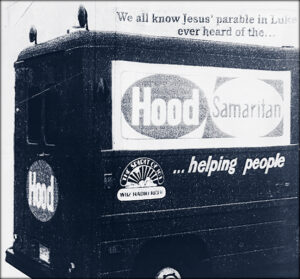
In the previous chapter, I mentioned that I had a “jailhouse lawyer” named Bill Wallace who played a key role in all of the things that had to be done in order to stage the White House transcript show in a prison, with two hundreds guests invited from the “outside.” After the two prison performances took place and the program was an enormous success, Bill came to me and said that if he could get a job outside and if I was willing to meet with the parole board, the chances were very good that he could be paroled. I told him that I was sure I could get him a job. It wouldn’t be a very high-paying job, but it would be a job, and certainly I would be willing to speak to the parole board on his behalf.
For the next few weeks, I tried to land a job for him among my many business contacts. I struck out every place I went. The best I could get for him was a menial job on a newspaper or loading dock or supermarket.
I soon realized that if Bill was to get a job, it would have to be something I created for him. So I began to think in those terms. One of my clients was HP Hood, a large New England dairy company. Its CEO and president was my old boss at United Fruit, Jack Fox. Jack’s job at Hood was to take the company public. He hired me to handle the financial public relations for Hood’s public stock offering.
I came up with an idea, called Jack, and set up a meeting a few days later. I took Jack over to his office window overlooking the Hood parking lot, where a hundred old milk trucks sat, most of them dirty and dented and rusting out. Months earlier, the company had stopped offering home delivery. I asked Jack for one of those trucks. Sure, he said, but he asked me what I wanted one for and pointed out that they were ready to be scrapped. I said I didn’t want one for myself, but I had an idea for a program for Hood.
I told him I wanted to put a man in the truck, who would be paid a minimum wage, work ten-hour days six days a week, looking for ways that to help people, primarily on Route 3, south of Boston. What kind of help? Jack asked. Whatever motorists needed, I said: a gallon of gas, a jump start, help fixing a flat tire. The truck could also cruise the city, helping elderly people with groceries or getting a cat out of a tree.
Jack knew a good idea when he heard one. He said to me, “I suppose you have ‘that guy’ in mind?”
I told him I did and then went on to describe the program before I told him anything about the guy in the truck. Finally, I got around to describing Bill Wallace—his intelligence, energy, street smarts, and personality. I told Jack that the truck would be repainted “The Hood Samaritan” and that Bill would be perfect for the job. I told him that Bill was a “hood” who had spent almost half his life in one prison or another, including the legendary San Quentin.
Jack made a quick decision: he thought it was a great idea and that Hood would do it. With that promise, I went before the parole board on behalf of Bill, and they agreed to let him out. Jack Fox, being Jack Fox, bought a new truck for the program and equipped it with everything from a hot-start battery to gas cans and radio-telephone so Bill could call police, fire, or ambulance, if necessary.
Jack asked me to attend the next meeting of the Hood board of directors and describe the program to them. Gilbert Hood, the former CEO, was the first to speak up. He said, “Over my dead body will you put a criminal in a truck with the Hood name on it.” An amazing bit of heated dialogue between Jack and Gilbert Hood followed. Jack reminded Gilbert that the function of the board was to hire and fire the president, and if the board decided to kill this worthy project, he would resign. Obviously, neither the board nor Gilbert wanted to see that happen, so they approved the program, albeit reluctantly.
The program was a success from the start and received tremendous coverage in the press, on tv and radio. Bill Wallace helped a lot of people, and after a year a second truck was added, covering the North Shore. The program began to get national publicity and in the second year, the coveted Silver Anvil was awarded by the Public Relations Society of America, to both the Hood Company and me, as the originator of the program. The Silver Anvil is the equivalent of an Academy Award.
In the next year or so, a decision was made that the Hood Company would not go public, and Jack Fox resigned from the company. A short time later, Gilbert Hood and his newly appointed president, Ed Gelsthorpe, got their way and canceled the program. We took the idea to several other potential sponsors (a newspaper, a supermarket chain, a couple of banks), but the company that showed the most enthusiasm, and the one we thought would bring more value to it, was CVS.
At the time, CVS was a relatively small chain based in Woonsocket Rhode Island, but the company had big ideas. Witness where it is today! Just as it was when Hood was its sponsor, the program became an immediate success under the sponsorship of CVS. It grew in Massachusetts, extended into Rhode Island, and then to other states.
The program is about fifty years old today. Bill Wallace left the program. (I don’t want to go into why.) I lost track of him. He might be eighty years old now, if he is still living.
Looking back over my long life, I am most proud of the fact that I came up with the idea for the Samaritan Program. It has helped so many people in need. I don’t think anybody knows the exact number of people it has helped. But CVS knows its value. Because if you get help on the road from someone you are never going to buy your pharmaceutical needs at any other place than CVS. This kind of a lasting, positive effect is something very rare in the business of public relations.