During the fateful Watergate summer of 1976, three friends of mine—two of whom worked for me part-time for years—were greatly affected by the Watergate cover-up and the conspiracy to obstruct justice. Their anger was part of the reason why the three of them—all friends—walked into a bank in Roxbury, Massachusetts, and attempted to rob it. Corruption in high places is obviously no excuse to rob a bank, but their lawyers and others would be looking for answers for their actions. To this day, I wonder why they did it. None of them had ever done anything like that before. They were good, hard-working young men but bad bank robbers. A teller tripped the silent alarm, and the police came, guns blasting. One of them was killed. The other two were captured, tried, convicted, and given twelve- to fourteen-year sentences in Walpole, a notorious maximum security Massachusetts prison.
Who were they? One was Mark Frechette, an actor cast in the lead in Michelangelo Antonioni’s only American film, Zabriskie Point. Frechette and his costar, Daria Halprin, were on the cover of Life magazine when the movie was released. His partner in crime was Terry Bernhard, a concert pianist and a brilliant man of many talents. I was shocked and saddened when I heard the news. These were my friends, and I wanted to help them. But what could I do? They did the crime, and had to do the time, even though I felt the sentence was excessive.
Then I got an idea. I had an Oval Office set in storage, some props, a few Brooks Brothers suits, and the Nixon nose in my desk drawer, as well as a successful script. Why not ask Mark and Terry to mount a stage version of the White House Transcripts in the prison? It would be a welcome distraction from their boredom, and it might just call attention to them and their case. The irony of having cons play the roles of the president and his men would make it grist for the publicity mill—which I knew something about.
With relative ease I convinced Governor Frank Sargent that such a stage play in prison, with convicts playing the role of Nixon and his men, was a good idea. He in turn convinced his commissioner of corrections, who was less enthusiastic about it but nevertheless approved. The prison authorities weren’t happy, but there was little they could do since it was approved by the governor and their boss. But that didn’t stop them from causing me problems. What I didn’t expect was a problem from the inmates, related to the prison auditorium, the only place we could stage the production. A handful of inmate groups had it tied up seven days a week, and they were not about to give it up. I sensed that the prison officials were delighted. They didn’t want outside people coming in and mingling with the prison population, perhaps seeing things the officials didn’t want seen.
Early in the planning stage, I got a call from the prison superintendent, who told me he was having a lot of problems with Black prisoners (he used the “n” word). “You better get your lily-white ass down here right away and hear it from them,” he said. “My advice is to forget about this crazy fucking idea of yours. Let your two bank robber friends do their time in peace.” I was there in the next hour.
The superintendent who ran the prison was not at all helpful. He had told me the first time we met that if it was up to him, he would ban all visitors from his prison. He made it clear he didn’t like me. He was big, overweight, not too smart, and mean. On his office desk he had a miniature electric chair, ten or twelve inches high. He told me it was a gift from one of the inmates in the prison he was at before he came to Massachusetts. It had a battery-operated silver metal headpiece that lit up, and he was very proud of it.
I met with the prisoners concerned in the so-called prison library, a small room with few beat-up paperbacks. There were six of them, each of whom represented a different organization or activity within the prison. They controlled the auditorium. There was a Black solidarity group, a jazz ensemble, a Black Muslim group, and two other Black organizations. On the weekends, they used the auditorium as a mosque. The superintendent turned the meeting over to me, and I began by explaining why we needed it for a full week. I told them we needed to move the set in and erect it. After that we needed to light it. We needed to rehearse, and to clean the auditorium and the bathrooms.
I didn’t appreciate it then, but I know now that men in prison have so little that when they get something, they want to hold on to it and never give it up, even temporarily. None of them was willing to give up their day, even once. I tried to explain that what we were doing would be good for the prison, that it would show people from the outside what the prison was like. I told them that inmates attending the performance could invite a guest from outside to sit with them. I said it would show the guests that inmates can be depended on to conduct themselves properly and appreciate a show like this, with its irony of having inmates play the parts of the former president and his staff. But these guys didn’t care about irony. They were unmoved by everything I said, and I knew it. Each spoke briefly. No more than a sentence. A couple just the word “no.” They were not giving up their day.
Sitting next to me was an inmate named Bill who had spent roughly fifteen of his twenty-nine years in one institution or another. He was a career criminal—a recidivist. He had served time in San Quentin for armed robbery and had been there with Charles Manson. The first time I heard the expression “dead man walking” was from Bill, describing Manson being taken from his cell in heavy chains. Manson was a very small man with a very white face flanked by four guards chanting that phrase, which echoed through the prison.
Bill would play Haldeman in the show. He was intelligent and very prison savvy. He knew a lot of people and how to get things done. He’d been very helpful to me in dealing with the prison officials. But not this day. At the other end of the room sat the superintendent, a couple of his assistants, and two guards. Near the superintendent was a man in his mid-thirties. After all groups had refused to give up their days, this man stood up and expressed his disappointment. He said it was selfish of them not to give up their day. He said that they were not thinking straight, that they were selfish. He listed all the benefits I had mentioned and went on to say that a couple of them had insulted me and owed me an apology. They sat there expressionless. They took it!
He then said that the meeting was going to be adjourned for ten minutes and that they should go outside, cool off, have a smoke, think about what I said, and talk among themselves. Ten minutes, he said. The inmates got up and walked out of the room and two guards went with them.
Who was this guy? What department was he in? He was tough and he was really cool. He was articulate. He was talking to hard guys. Murderers, some of them. Lifers. He was dressed in light tan gabardine pants held up by an alligator belt. He had on a long-sleeve maroon gabardine shirt that looked like it was tailor-made. Unlike most men in prison, his hair was long but neatly trimmed. He was clean shaven. After the men left, he stood up and looked at his gold wristwatch. He remained standing, arms folded, looking off into space. I turned to Bill and asked who this man was and what department he was from. Bill seemed nervous. He whispered that he would tell me later.
Ten minutes later the six came back into the room. Once everyone was seated, the man who had adjourned the meeting took his seat and got right to the point. He spoke in a firm voice and said, “No speeches: Yes or no.” He started with the one who had been the most adamant, the most articulate, and the most insulting. I found out later that he was a convicted cop-killer and a lifer. “I’m OK with giving up my day, Frank,” he said. So the guy’s name was Frank. Frank did not react and moved on the next man. He also said he was OK with it. And so it went. It was over in less than three minutes.
“Thank you, gentlemen,” Frank said, “you made the right decision. This meeting is adjourned.” At that point, the inmate who ran the mosque pointed at me and said that he noticed I had moved in a gold rug with the scenery. He wondered if I would leave the rug for his mosque after the production ended. Frank just looked at him. The meeting ended.
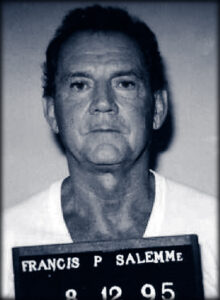
I was shocked. I had been in a lot of meetings, but never one like this. Frank walked up to me. I told him how much I appreciated what he had done and asked what department he was in. He smiled and said, “My name is Frank Salemme. I am an inmate here. I run the Italian-American club in the prison.” He said he believed that what we were doing would be good for the institution and that the Italian-American club would guarantee security on the nights of our performance. There would be no catcalls or any other bad behavior. He also said that his club would cater the parties after the two performances, providing cigarettes, soft drinks, and cannolis from Boston’s North End.
I later found out that Salemme was a made man, in the Mafia, and he had been convicted of planting a bomb in a Boston lawyer’s car at the request of the Mafia don Raymond Patriarca. Little did I know that he would be in and out of my life for the next fifty years.
The two performances took place as planned, the first one on a Friday night, the second the following night. Mark and Terry worked very hard. Mark was the director. Terry was Nixon. I got our makeup man to come into the prison. (You can imagine the problems created by a makeup man coming into prison.) Terry wore the Nixon nose. They all were outfitted in suits, white shirts, and ties. At one point we started to run out of money. Bill went to work and won a couple of hundred dollars in an all-night poker game. He was by far the best poker player in the prison.
Over a hundred inmates attended each performance. There was not enough room for everyone to attend, so attendance was determined by a lottery. Every inmate with a ticket was able to sit with one member of his family or a friend. Almost all the inmates took advantage of that offer.
Each night forty seats or so were occupied by people we invited from the community, including the governor, Senator Ed Brooke, several congressmen, state officials, a federal judge, and freelance writers, college professors, and the media. There were no introductions. That night everyone was an ordinary citizen attending an extraordinary performance.
The media came out in force. Local and national newspapers covered it. A young Charles Osgood of CBS News came up from New York with a crew, which made it a national story. People magazine covered it and even managed to get videotape of the robbery to illustrate the story. There was not a single security or behavioral problem over the two nights. Frank Salemme threw a great after-performance party for the guests from the community, with soft drinks, Italian hors d’oeuvres, cigarettes, and tons of cannolis.
Checking everyone for drugs, weapons, and other contraband before they entered the prison had been a security nightmare for the prison. It took time and personnel. Visitors had to go through two traps to enter the prison. That took time. Joan had to be stripped-searched by a female guard because the metal stays in her brassiere set off the super-sensitive metal detector. And she wasn’t the only one. In the morning all the inmates were accounted for. Nobody escaped and nothing was broken or stolen.
In the weeks that followed, several other prison inmates requested similar performances of the White House Transcripts. Those requests were denied. Terry was paroled early. Mark was denied parole and would need to wait several months for his parole hearing. He was murdered before that could happen. Frank Salemme was not the only one who remained in my life after this experience. Bill was another.