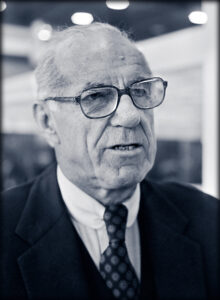
In 1955, not long after United Fruit’s involvement in the overthrow of the Guatemalan government, I was working in the public relations department when our advertising agency alerted us to the fact that a new paperback edition of Dr. Benjamin Spock’s wildly popular book on infant and childcare was going to accept selected advertising. The agency strongly recommended we take several pages of that advertising to extol the nutritional value of bananas and show parents how they could use bananas for the family, primarily in baking and desserts.
We followed up on the recommendation, and when the book was published, I received a couple of advance copies, which I stuck on my office bookshelf and forgot about. But two years later, when Joan and I welcomed our first born, Alison, into the family, I brought a copy home to our apartment in Queens. Joan read it and liked Dr. Spock’s philosophy of raising children so much that we used it as we raised all four of our children over the coming years.
Nearly fifteen years later, on a snowy winter’s day in 1969, I was taking the Eastern Airlines shuttle from Boston to New York. I took a window seat and watched the deicing truck getting the wings of our old plane ready for takeoff. My seatmate appeared, an elderly man who was standing in the aisle and stuffing his coat into the overhead bin. I couldn’t see his face, but I did notice that he wore a wrinkled blue suit with a badly stitched repair to one of its pockets. I went back to watching the ground crew servicing the plane.
The man eventually sat down and immediately extended his hand. “Hi,” he said. “Ben Spock.”
“Tom McCann,” I said. “And I know who you are.”
By this time Benjamin Spock was more than just the author of one of the best-selling books in history. He had also become a prominent political activist, supporting a variety of left-wing causes, including civil rights and nuclear disarmament. He had been arrested several times for acts of civil disobedience, including pouring fake blood down the conning towers of nuclear submarines. And, as you would expect of someone of his political beliefs, over the past few years he’d been one of the most vocal critics of United Fruit.
We made conversation, and I mentioned that Joan and I had raised our kids on his book. After a few minutes, he said, “So, Tom, what do you do for a living? And don’t tell me,” he said with a chuckle, “that you’re a lawyer.”
“No, Doctor,” I said. “I’m not a lawyer. I work for a big company here in Boston.”
He peered at me and said, “I have a feeling you don’t want to tell me the name of your company—most people I know would say they worked for IBM or General Motors or whatever.”
“Well, you’re right, and I might as well just get this out of the way—I work for United Fruit. I’m director of public relations, and my work these days is mostly trying to put a better face on the company.”
He settled back in his seat and didn’t say anything for a couple of minutes. Finally, he turned to me and said, “You know, if we ever get off the ground, I think we’re going to find a lot of other things to talk about on this trip. So let’s agree not to talk about your job and what I think is my job.”
“OK,” I said.
“Tell me about your children and how you came to raise them on my book.”
I told him the story about the 1955 edition and how I brought the book home and how it went through a couple of moves including the move to Boston and how after four kids the book was dog-eared and covered in stains I couldn’t identify and how the binding was dried out and there were some pages missing. But that book, I told him, was like a family bible to us. He told me he was happy to hear that, and he talked about the tens of millions of copies it had sold and how many languages it had been printed in, including the millions of copies it sold in Japan. He seemed to be delighted that, as he put it, millions of “Jap kids” had been raised on Dr. Spock.
He had a keen sense of irony and was delighted that Vice President Spiro Agnew (very much an adversary of the left wing) had recently mentioned him in one of his speeches and referred to the kids who were raised on his book as “Spock-marked kids.” The phrase was coined by Bill Safire, who I had known long before he was speechwriter for the Nixon administration and a columnist for the New York Times. Safire had been a PR guy and the one who took the famous picture of Nixon wagging his finger at Nikita Khrushchev in 1959.
The flight finally took off, and Ben Spock and I continued our delightful conversation, with no political discussions or mentions of United Fruit. When we landed at LaGuardia, he suggested we get a cup of coffee and a doughnut, and we continued our chat at one of the high tables in the terminal before getting a cab. I asked him where he wanted to be dropped off, he gave me his address on the Upper East Side. We exchanged telephone numbers in the cab, and he said he would call me the next time he visited his son Michael in Boston.
After he got out of the cab and just before it was about to pull away, he doubled back and tapped on the window.
“Tom, don’t tell anybody that I accepted a ride paid for by United Fruit!”
A month or two later he called and invited me to meet him at Boston Children’s Museum. Ben’s son, Michael, was the museum’s director. We had a nice lunch, and he was as delightful company as he had been on the plane. I never met him after that, but Michael and I became friends. I would never forget that airplane conversation and I would never forget Ben Spock—a man of many parts, a towering intellect, and a very good physician, I’m sure, in his doctoring days. He had finished first in his class at Columbia Medical School and won gold medal for rowing in the Olympic games. And, of course, he was the man who helped Joan and me raise our four children.